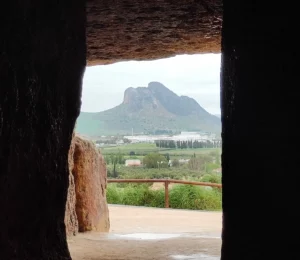
The Murillo Gardens are the green strip that separates the Santa Cruz neighbourhood on Menéndez Pelayo Avenue, right next to the walls of the Real Alcázar. 8,500 square metres lined with orange trees, bougainvillea-covered pergolas and tiled benches.
Free admission, and they provide the best shade in the centre of Seville in summer.
They are from free and open access, with no ticket office or security checks.
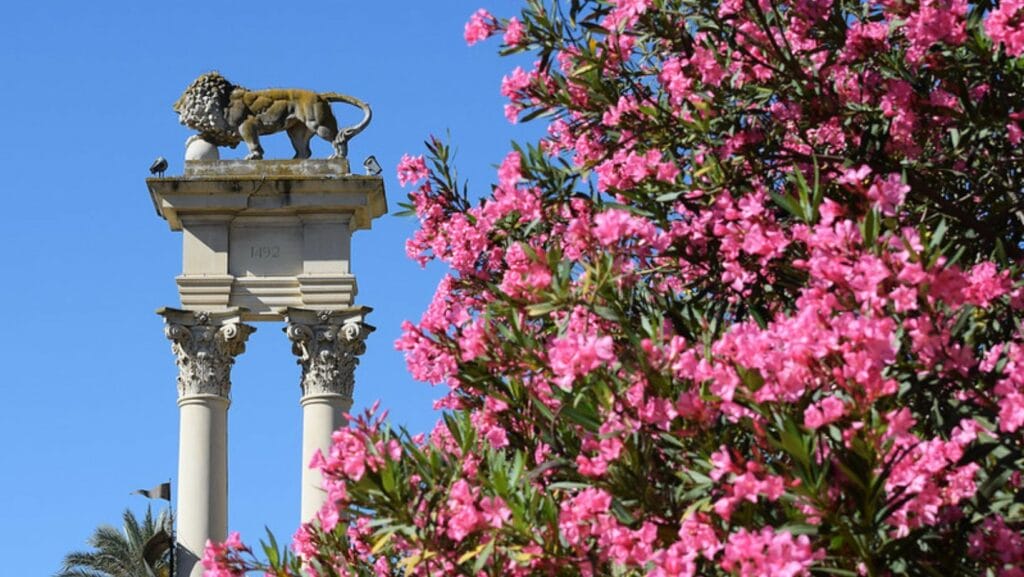
This is the first thing to look at, and it’s worth examining it in detail because it is very often described incorrectly. It measures 23 metres and took up a position at 1921:
The whole complex stands on the circular bowl of a platter.
It wasn’t funded by the council. The idea came from José Laguillo y Bonilla, editor of the newspaper The Liberal, which in 1917 launched a public subscription to fund it.
And the creators did it for free: the architect Juan Talavera y Heredia designed the project and supervised the work without charging a fee, and the sculptor Lorenzo Coullaut Valera, from Marchena, created the lion and the bust.
Here’s what you need to know before you come. Nobody in Seville calls it the Columbus Monument: it is the lion fountain, because of the figure that crowns it.
And from that come two stories that are still told today:
The ensemble is designated an Asset of Cultural Interest since 2002.
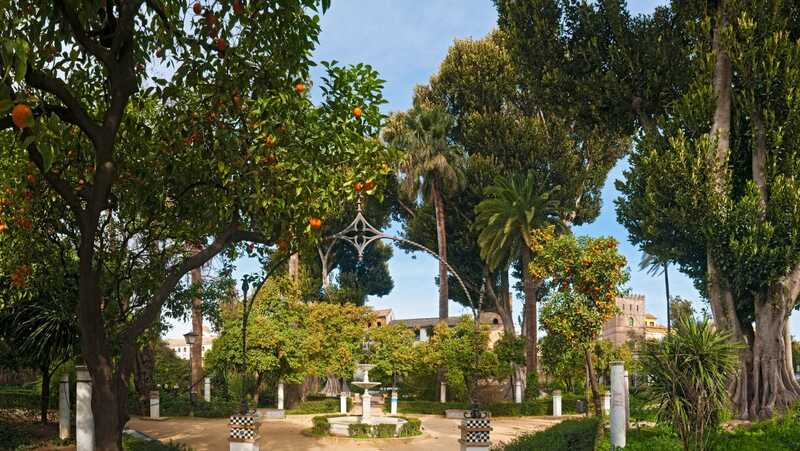
They’ll be here in twenty minutes, but there are four specific things to look out for:
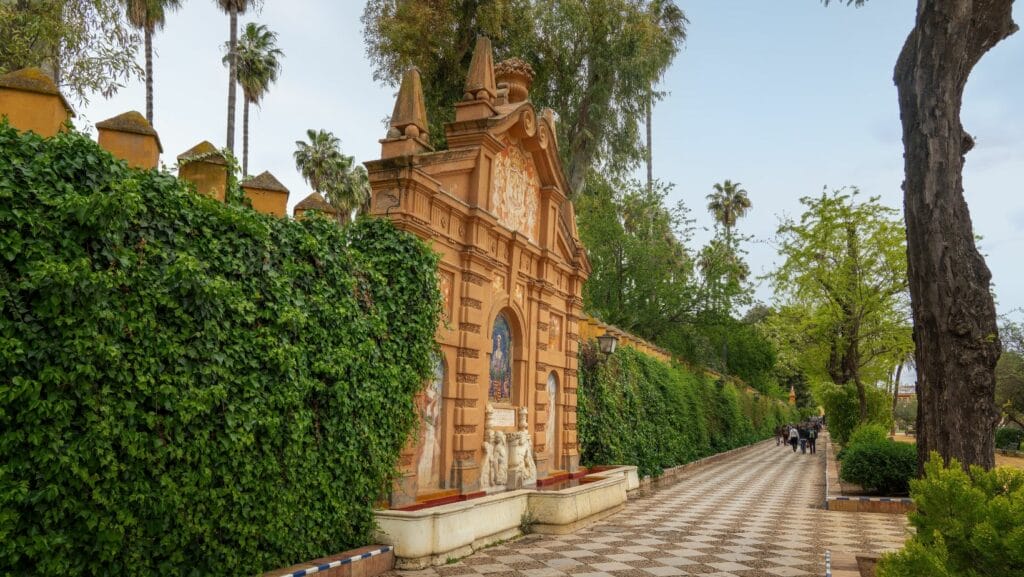
It is built against the wall separating the gardens of the Alcázar. It is his own work Juan Talavera and it has side paintings by Francisco Maireles. It is dedicated to the founder of the Hospital de las Cinco Llagas.
Almost everyone skips this bit. A tower and several sections of the ancient city wall, and in them you can see the aqueducts that carried water from the springs at Carmona to the Alcázar. It is Roman hydraulic infrastructure that has been reused for centuries.
In the centre of the gardens, framed by entrance arches and low tiled walls. It is dedicated to the Sevillian painter of genre scenes.
The gardens end here, in a square dominated by the statue of Don Juan Tenorio.
A point that is often misunderstood: The myth of Don Juan was created by Tirso de Molina at The Trickster of Seville, in the 17th century, but the work entitled Don Juan Tenorio It is by José Zorrilla, from 1844, and it was this that made the character famous.
For centuries, the land formed part of the gardens of the Real Alcázar —they were known as the Retiro Gardens— until, at the start of the 20th century, they were handed over to the City Council to create a public garden. Sections of the city walls were demolished to link the south-east of Santa Cruz with the historic ring road.
They were originally called the Talavera Gardens, by the architect. In 1918, they changed their name to de Murillo in honour of Bartolomé Esteban Murillo, the great Sevillian Baroque painter, who lived and died in this neighbourhood in 1682.
They are right in the centre, between Callejón del Agua and Avenida de Menéndez Pelayo. It’s just a few minutes’ walk from the Cathedral, going round the Alcázar, and the nearest tram and bus stop is at Archivo de Indias / Puerta de Jerez.
Don’t look for a parking space: It’s practically impossible in this area. Get around on foot.
The logical way to link them is as follows:
The whole ensemble, in Seville’s 15 must-sees, and nearby there is also the Plaza de España.
We are a local tour operator based in Málaga with over 50 years’ experience organising trips around Andalusia. Seville is just over two hours away and makes for a day trip:
From 8.00 am to 10.00 pm in winter and from 8.00 am to midnight in summer. It is a public urban park with free, unrestricted access – there is no ticket office or entry control – situated between Callejón del Agua and Avenida de Menéndez Pelayo.
Because of the figure that crowns it: a lion with its paw resting on a globe. That is the name the people of Seville use, and two local customs stem from this: children were told they had to leave the gardens because the lion had to come down to drink from the fountain, and tourists who ask where Columbus is are told that the lion ate him, as there is no statue of him, only a medallion on the plinth.
It measures 23 metres and consists of a plinth and two stone Corinthian columns representing the Pillars of Hercules. Halfway up, between the two columns, there are two bronze caravel prows bearing the cartouches of Isabella and Ferdinand; on the plinth, two marble medallions featuring a bust of Columbus and the coat of arms of the Catholic Monarchs; and at the top, a lion standing on a globe. The whole structure stands on the circular basin of a fountain.
It was funded by public subscription, an initiative launched in 1917 by José Laguillo y Bonilla, editor of the newspaper *El Liberal*. The architect Juan Talavera y Heredia designed the project and supervised the construction free of charge, whilst the sculptor Lorenzo Coullaut Valera created the lion and the bust. The monument was erected in 1921 and has been a Site of Cultural Interest since 2002.
Named in honour of Bartolomé Esteban Murillo, the great Sevillian Baroque painter, who lived and died in the Santa Cruz neighbourhood in 1682. They were previously known as the Jardines de Talavera, after the architect who designed them, and the name was changed in 1918. For centuries, the site had formed part of the orchards of the Real Alcázar, known as the Huerta del Retiro.
The Catalina de Ribera Fountain, set against the wall of the Alcázar, with murals on either side by Francisco Maireles; the remains of the city wall, where the pipes that carried water from the Carmona springs to the Alcázar can be seen; the bandstand dedicated to the painter José García Ramos; and the Plaza de Refinadores, where the gardens end, dominated by the statue of Don Juan Tenorio.