The Torre del Oro It’s the cheapest tour in the centre of Seville: 3 €, including the museum and terrace.
And on Mondays it’s free, although there’s a catch.
Approximate timetable: from Monday to Friday from 9.30 am y Saturdays and Sundays from 10.30 am, closing late in the afternoon, with the last screening before that.
Close 1 and 6 January, Good Friday, 1 May and 25 December.
It runs from Tuesday to Thursday. It sounds a bit odd given that there’s a free day, but:
And the time: the opening match or the last match of the afternoon. The evening light from the terrace is definitely better, although there are more people.
Timetables and fares are set by the Spanish Navy and may vary on public holidays, during Holy Week, the April Fair or due to official events. Tel. 954 22 24 19.
Between half an hour and forty-five minutes. The interior is small — the tower itself sets the limit — so it’s a short visit that fits in well with other sights.
It does not include an audio guide or a guided tour. There are information boards, but if you want an explanation, you’ll have to book one separately.
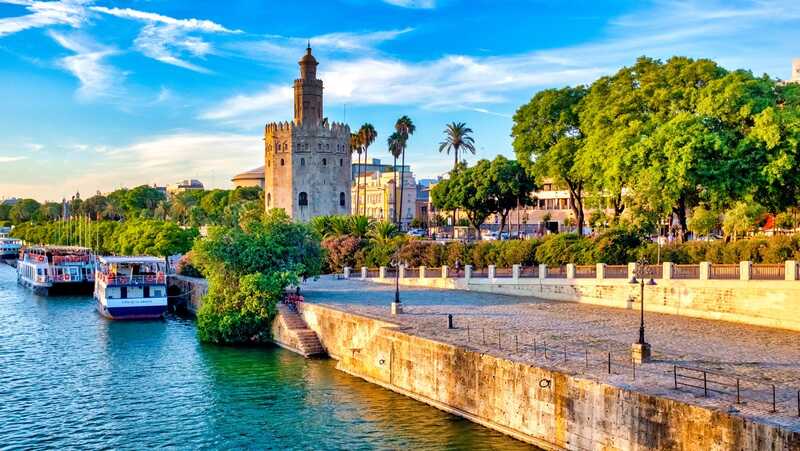
It is a watchtower, and it’s worth knowing what it means: a tower separate from the main section of the wall and connected to it by a fortified section known as coracha. That design made it possible to attack the enemy from the flank.
And it has a dodecagonal plan, with twelve sides. It is rare, and it explains something that catches the eye: The tower seems to change shape depending on where you look at it from.
It is 36 metres long and is organised into three bodies that do not date from the same period:
It was built between 1220 and 1221, under the Almohad governor Abu l-Ula, with a very specific function: block the passage along the Guadalquivir.
A thick chain ran from the tower which crossed the river to another tower on the Triana bank. No vessel was travelling up the river without permission.
He was defending the river approach to the Barcas Bridge and, by land, access to Arenal.
And one forgotten companion: the Silver Tower, on Santander Street, which was connected to it by the city wall. It is still standing, yet hardly anyone goes to see it.
Guard post, prison —in the early 15th century—, chapel, gunpowder store and port office. He also served as secure facility for precious metals which the West Indies fleet had brought back.
And the legend goes: it is said that the tower also served as a setting for the king’s discreet trysts with the ladies he was courting.

Let’s start by ruling out the most commonly cited explanation: It isn’t called that because it used to hold the gold from the Americas.
The gold was arriving at the neighbouring quay, but was kept in the Treasury Chamber of the Casa de la Contratación, at the Alcázar, and was processed at the Royal Mint. It is the proximity of the quay that explains the confusion, not the name.
The real reason is the shine. His Arabic name was Borg-al-Azajal, referring to the golden glint it cast upon the water.
And here is the exact figure: For a long time, that shine was attributed to tiles. The 2005 restoration work established that it originated from a coating of lime mortar mixed with pressed straw, which reflected the sunlight as if it were gold.

It occupies the two lower sections from the tower 1944, and it depends on the Spanish Navy.
What's up: model ships, antique navigational instruments, nautical charts, engravings and documents relating to navigation on the Guadalquivir and the port’s role in trade with the Americas.
It isn't big —the tower imposes its limits— but it’s well executed, and There are QR codes for each item for people with visual impairments.

It’s the highlight of the visit, and that’s what justifies the €3. From above, you can see the Guadalquivir, the Triana Bridge, the Triana district and the Giralda.
Set aside some time for her: Many people spend time in the auditoriums and then rush up at the end.
It’s on the Paseo de Colón, next to the Maestranza Bullring, in a pedestrianised area. It’s one of the easiest places to fit into your itinerary:
And the neighbourhood where it is, in El Arenal. The squares in the surrounding area, in the squares of Seville.
We are a local tour operator based in Málaga with over 50 years’ experience organising trips around Andalusia. Seville is best explored in a day:
The tower is a great way to spend your free time: half an hour and €3. It’s on the riverside promenade, on the way to the Maestranza.
More about the destination: what to see in Seville, Seville in a day y the Plaza de España.
A general admission ticket costs three euros, which includes access to the Naval Museum’s exhibition rooms and the upper terrace. A reduced-price ticket costs 1.50 euros for children aged 6 to 14, students, over-65s and groups, and admission is free for children under 6 and people with disabilities. On Mondays, admission is free for everyone.
Tuesday to Thursday. Although entry is free on Mondays, it gets very busy on that day and the interior is quite cramped; at the weekend, moreover, it opens an hour later and attracts large numbers of visitors. For three euros on weekdays, the visit is much more peaceful.
Because of the golden reflection it cast upon the river, from which its Arabic name, Borg-al-Azajal, derives. The 2005 restoration revealed that this sheen came from a coating of lime mortar mixed with pressed straw, not from tiles. The claim that the gold from the Americas was kept there is false: it was guarded in the Treasury Chamber of the Casa de la Contratación and processed at the Royal Mint.
A tower set apart from the main section of the wall and connected to it by a fortified passage known as a ‘coracha’. This design made it possible to attack the enemy from the flank and, in this case, to control river traffic entering Seville. The Torre del Oro also has a dodecagonal floor plan, with twelve sides, which explains why it appears to change shape depending on the angle from which it is viewed.
Between thirty and forty-five minutes, including the museum galleries and the walk up to the terrace. The tour does not include an audio guide or a guided tour, only information panels, so anyone wishing to have an explanation will need to book one separately.
To block off the passage along the Guadalquivir. A thick chain ran from the tower across the river to another tower on the Triana bank, ensuring that no vessel could navigate upstream without authorisation. It defended the river entrance to the Puente de Barcas and, by land, the access to the Arenal.