Granada boasts a tradition of confectionery with Arab and monastic roots, in which the Al-Andalus heritage of almonds, honey and cinnamon coexists with the recipes developed over the centuries by cloistered convents. The result is a range of sweets closely linked to the region, with almost every village contributing its own speciality. In this guide, we explore 8 traditional sweets from Granada, stating their geographical origin and what each one consists of, so that you know what to try if you visit the city and its surrounding area.
Aside from piononos, which are the iconic symbol of Granada’s pastries, you’ll find sweets associated with specific dates, such as the huesos de santo in November or the huevos moles at Easter, and others that are only made properly in their village of origin, in the Alpujarra or on the coast. If you’d like to try them where they’re made, a day trip to Granada Travelling from Málaga gives you time to explore its patisseries and convents without having to worry about transport or parking.
These are the eight sweets that best represent Granada’s confectionery tradition, listed from the best known to the most local. Each one is associated with a village or region within the province, allowing you to follow a short sweet-tasting trail beyond the capital.
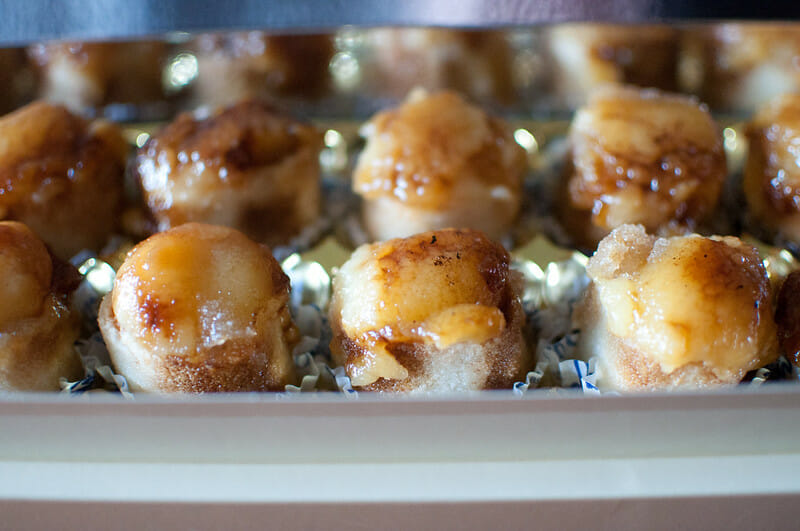
The pionono is Granada’s most traditional sweet and originates from the town of Santa Fe, just a few kilometres from the capital. It is a small cake made up of a thin sheet of sponge, rolled up and soaked in syrup, topped with a toasted cream. It is eaten in a single bite.
Its story has a name of its own: it was created by Ceferino Isla González, a master pastry chef who, in 1897 opened his workshop, Casa Ysla, on Calle Real in Santa Fe. A man of great devotion to the Virgin, he wished to pay homage to the Pope Pius IX —Pius IX in Italian, from whom the sweet takes its name—, who in 1854 had proclaimed the dogma of the Immaculate Conception.
And the shape is no coincidence: it replicates the figure of the Pope. The cylindrical, somewhat plump sponge cake is the body; the pleated paper basket that wraps around it represents the balandrán white; and the toasted cream topping mimics the solideo which covers the Pope’s crown. In 1916, the sweet found its way into the King’s hands Alfonso XIII, who was so pleased that he granted Casa Ysla the title of official suppliers to the Royal Household.
There is also an alternative theory which traces its origins back to Al-Andalus confectionery of the 10th and 11th centuries, with its use of cinnamon and honey, the recipe for which is said to have been preserved by the residents of Santa Fe. In any case, it is the most common sweet treat that visitors take home with them, and it can be found both in Santa Fe and in the bakeries in the centre of Granada.
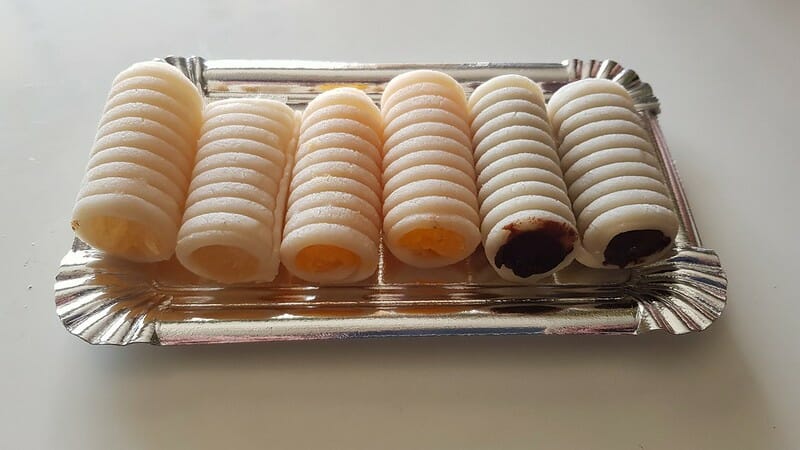
Huesos de santo are a seasonal sweet made around All Saints’ Day, on 1 November, and are also served during Holy Week. They are made from a dough of almond marzipan Shaped like a tube, resembling a bone, they are traditionally filled with egg-yolk jam and coated in icing sugar.
Although they are found throughout much of Spain, in Granada they are an indisputable part of the festive calendar and are sold at this time of year in bakeries and convents. Their small size makes them dangerously easy to eat one after another.
Buñuelos are a sweet fried treat traditionally associated in the province with Lanjarón, at the entrance to the Alpujarra. They are made from a simple dough of flour, olive oil and yeast, shaped into small portions which are deep-fried, sprinkled with sugar or drizzled with honey, and eaten whilst still hot.
They are associated with the village’s festivals and pilgrimages, where they are made fresh on the spot, and are a winter classic: enjoyed with a hot chocolate when the temperature drops. They are a fine example of that simple, traditional confectionery that exists alongside the more elaborate sweets of the capital.
Borrachuelos are a traditional sweet from the Alpujarra, closely associated with villages such as Pampaneira. They are deep-fried, filled pastries, flavoured with wine y matalahúva —aniseed— and sesame seeds, which are then coated in sugar or dipped in honey.
They are mainly made at Christmas and during Holy Week, when they are served at family meals. Their name refers specifically to the wine added to the dough, which gives them their characteristic aroma.
If you are in Malaga or the Costa del Sol we recommend you to do the excursion to Granada to learn more about its history and culture:
Excursion to Granada with entrance tickets to the Alhambra from Malaga
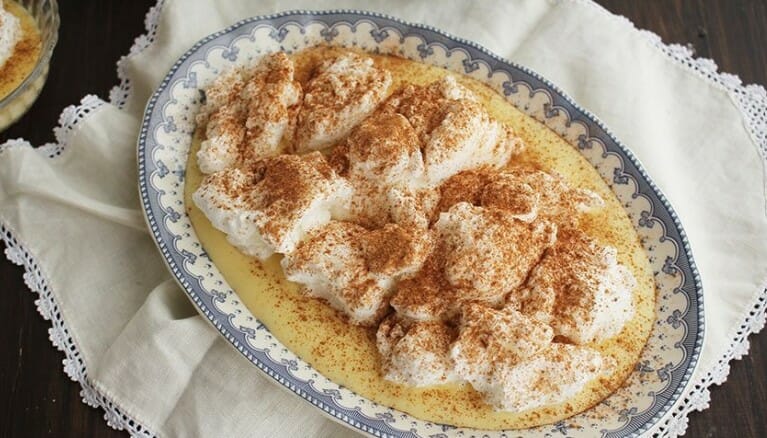
Huevos moles are a convent-style sweet made from egg yolk and sugar cooked until they form a thick, golden cream, flavoured with cinnamon. They originated in the convents of Granada, and are specifically attributed to the nuns of San Antón, who came up with them as a way of using up egg yolks left over from other recipes.
In Granada, they are associated with Holy Week, when they are often eaten alongside ‘huesos de santo’. They are eaten on their own, by the spoonful, or as a filling for other sweets, and they keep the city’s monastic confectionery tradition alive.
Tocinillo de cielo is another sweet with monastic origins, which is very common in the region of Guadix. It is made with egg yolk and a sugar syrup which, when set, forms a firm, glossy and very sweet dessert, amber in colour, sometimes flavoured with cinnamon or lemon zest.
It shares its origins with huevos moles, as both make use of the egg yolk — a tradition inherited from the days when egg whites were used to clarify wine — but tocinillo is served in individual portions shaped like small ingots. It is a classic in the region’s traditional patisseries.
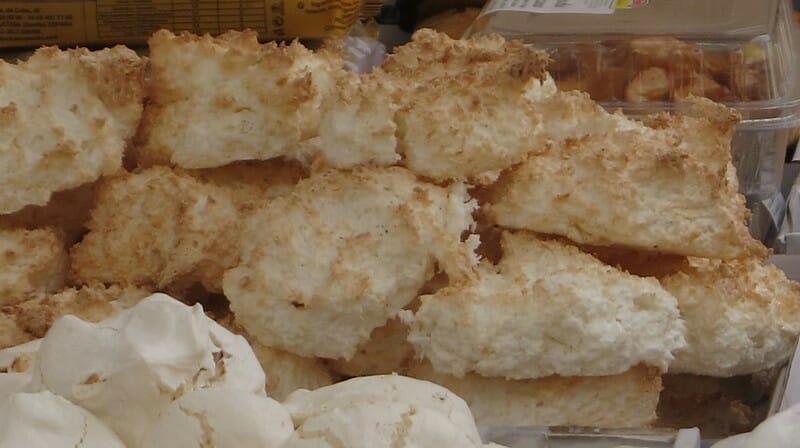
Whistling is a almond meringue A traditional sweet from the Alpujarra region of Granada, of Moorish origin. They are made with whipped egg white, sugar and local almonds, and baked until light and crisp on the outside. Their airy texture explains their name.
They are a common feature at Christmas and once again demonstrate the importance of almonds in the province’s confectionery, a direct legacy of the Andalusian tradition.
The ‘torta real’ is the most iconic sweet in Motril, on the Granada coast. It is a dessert made of almonds and sugar, covered with a layer of white icing and often decorated with chopped almonds or simple embellishments. Its connection with sugar cane is no coincidence: for centuries, Motril was the sugar-producing centre of the coast.
Also with its roots in convent baking, it is sold in portions and as whole cakes, and is particularly typical during the winter months, around Christmas time. It brings this tour of Granada’s traditional sweets to a fitting close by combining the coastal region’s contribution with those of the capital, the Vega and the Alpujarra.
In Granada, traditional sweets are mainly bought in two places: the traditional bakeries and pastry shops in the city centre, and the cloistered convents. The historic patisseries in the old town specialise in piononos, tocinillos and seasonal sweets, and are the most convenient option for visitors who are short on time. As for piononos, the most authentic way to buy them is from the confectioners’ in Santa Fe, where the sweet was first made and where Casa Ysla still uses the original recipe.
Another option is the convents of Granada, which have preserved their cloistered baking traditions and sell their homemade sweets, often through a hatch. This is the best way to try huevos moles, tocinillos and other convent sweets made in the traditional way. If you’d like to combine buying sweets with a savoury break, we can advise you on Where to eat tapas in Granada in the city centre.
The most typical sweet in Granada is the pionono, which originates from Santa Fe, a few kilometres from the capital. It is a small cake made of rolled sponge soaked in syrup, topped with a toasted cream, which is eaten in a single bite. It was created by the pastry chef Ceferino Isla in 1897 and can be found both in Santa Fe and in the patisseries in the centre of Granada.
The pionono takes its name from Pope Pius IX, known in Italian as Pío Nono. Its creator, Ceferino Isla, wished to pay tribute to the pontiff who, in 1854, proclaimed the dogma of the Immaculate Conception. The shape of the sweet also mimics the figure of the Pope: the cylindrical sponge cake is the body, the pleated paper basket represents the white cape, and the crown of toasted cream represents the skullcap.
The most famous sweet in Granada is once again the pionono from Santa Fe, as it is the iconic symbol of Granada’s confectionery both within and outside the province. Alongside it, other well-known sweets stand out, such as the ‘huesos de santo’ in November, the ‘huevos moles’ at Easter and the ‘torta real’ from Motril, which round off the region’s sweet treats.
Granada’s traditional sweets are mainly bought in the traditional bakeries and pastry shops in the city centre and at the cloistered convents, which sell their homemade pastries, often through a serving hatch. For piononos, the most authentic way to enjoy them is to buy them in the confectioners’ in Santa Fe, where the sweet originated.
These eight sweets give a fairly comprehensive overview of Granada’s confectionery tradition and how each village contributes its own speciality. To continue planning your trip, you can consult the a hub for excursions and experiences in Granada and our guide to What to see in Granada. And these are the day trips to Granada that depart from Málaga: