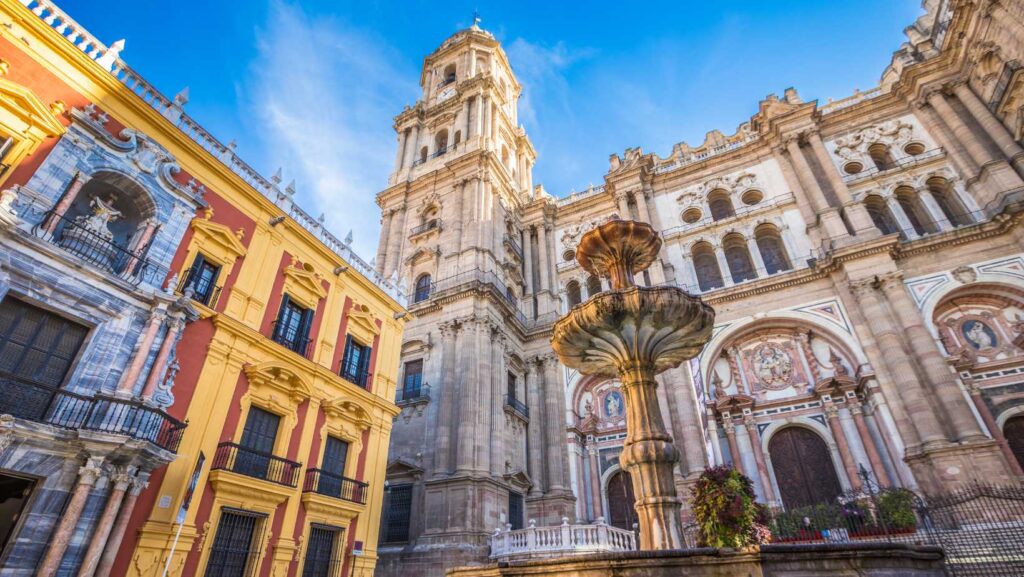
The Bishop's Square It is the forecourt of Málaga Cathedral: a pedestrianised area with the cathedral’s façade on one side, the the façade of the Bishop’s Palace opposite, with a grey stone fountain in the middle.
It’s one of the most photographed spots in the city. And it hides a celebration that takes everyone by surprise.
Every 4 July, the Plaza del Obispo is hosting the commemoration of the Independence of the United States, featuring a recreation of the Battle of Pensacola.
And it’s not just a quirk: that battle of 1781 she won it Bernardo de Gálvez, a soldier born in Macharaviaya, in the Axarquía region of Málaga. Spain supported the colonists against the British, and the capture of Pensacola proved decisive.
If you happen to be there on that date, you’ll see 18th-century uniforms right in the centre of Málaga.
It is the finest civil façade in the city centre, and it is worth looking at it closely because it is designed like an altarpiece:
Work began in 1762, with the bishop José Franquis Lasso de Castilla, which she paid for using the so-called «Dignity Allowances»: 150,000 ducats a year.
The architect was Antonio Ramos, chief master builder of the Cathedral. And when he died in 1782, he continued them José Martín de Aldehuela, the same man who, years later, would build the New Bridge of Ronda.
Many people walk right past it without realising it’s open to visitors. The palace houses ARS Málaga, the Diocese’s art space, which opened in 2014.
What you can see inside:
Indicative prices: general discussion on 4 €, with a reduced fare for residents of Málaga and the surrounding area, y free for children under 12.
And here’s a money-saving tip: there are combined ticket with the Cathedral, which works out much better than paying for both separately. Check opening times and prices before you go, because they vary depending on the duration of exposure.
Small but steeped in history. It is from 1785, by grey stone, just like the façade of the palace, with two cups and a pineapple from which the water flows.
The details: the water came from the San Telmo aqueduct, the great hydraulic engineering project that supplied Málaga for centuries.
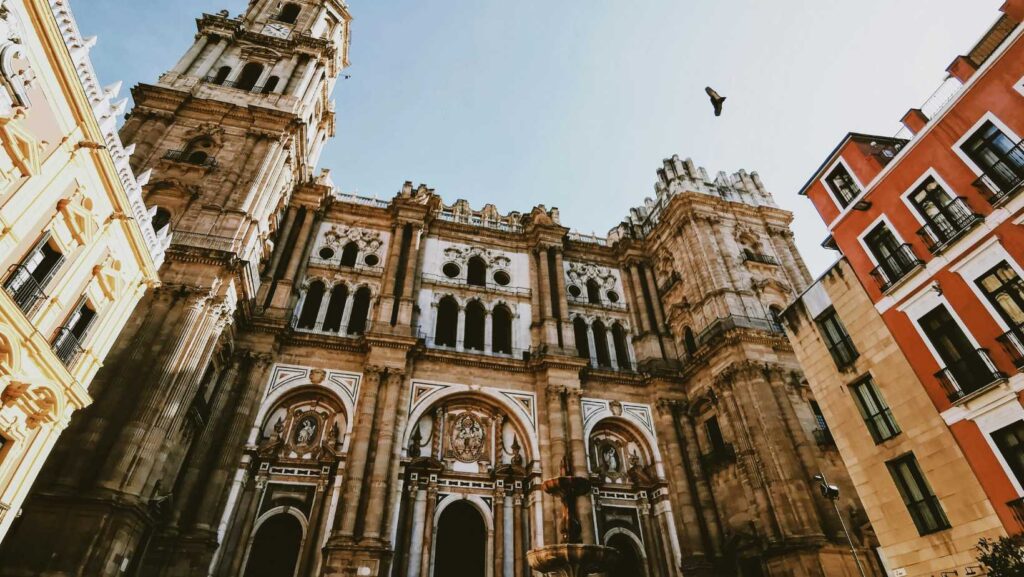
From the square, you can see the best view of the façade of the Cathedral of the Incarnation, «La Manquita» because of its unfinished south tower.
A clarification that is often misinterpreted: on The interior is Renaissance in style, but The façade you can see from the square is Baroque. Construction went on for centuries, which is why the two styles coexist.
Full details at Malaga Cathedral.
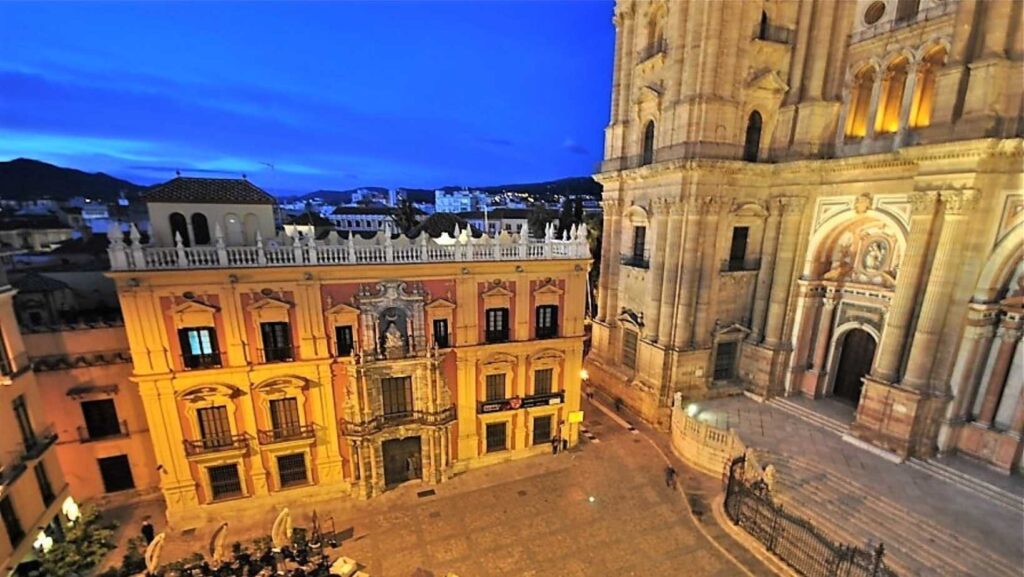
For the photo: Stand next to the Bishop’s Palace and frame the Cathedral in your shot. That’s the angle that works.
The square, the palace and the cathedral appear in The Bridge of San Luis Rey (2004), where they portray the city of Colonial Peru in the 18th century. When you look at the whole picture, you can understand the choice.
You’re right in the heart of the city’s historic centre, with everything less than five minutes away:
You’ve sorted them into The 8 must-see monuments in Málaga, and to get in for free, free museums y free things to do in Málaga.
We are a local tour operator based in Málaga with over 50 years’ experience organising trips around Andalusia. If the city centre isn’t quite enough for you:
You’ve got the whole city at your fingertips What to see in Málaga in three days and destiny in The Malaga Guide.
Because the independence of the United States has a direct link to Málaga. Every 4 July, the Battle of Pensacola – won in 1781 by Bernardo de Gálvez, a military officer born in Macharaviaya, in the Axarquía – is re-enacted in the square. Spain supported the colonists against the British, and that victory proved decisive for the outcome of the war.
Yes. It houses ARS Málaga, the Diocese’s art gallery which opened in 2014, featuring sacred art from the 15th to the 18th centuries and a permanent collection of African art on the ground floor. Highlights inside include the double-flight imperial staircase featuring the fresco of the Triumph of the Eucharist, the two courtyards and the Throne Room. It is advisable to check opening times and admission fees before visiting, as these vary depending on the exhibition.
General admission is around 4 euros, with a reduced rate for residents of Málaga and the surrounding province, and free entry for children under 12. There is also a combined ticket with the Cathedral, which works out cheaper than buying both separately, so it’s worth asking about it at the ticket office if you’re planning to visit both.
Work began in 1762 under Bishop José Franquis Lasso de Castilla, who financed it using what were known as the ‘revenues of the Dignity’. The project was designed by Antonio Ramos, the cathedral’s chief master builder, and following his death in 1782, the work was continued by José Martín de Aldehuela, the architect who, years later, would build the Puente Nuevo in Ronda.
Both, depending on how you look at it. The interior is predominantly Renaissance, but the façade as seen from the Plaza del Obispo is Baroque. Construction of the church spanned several centuries, from 1528 to the 18th century, and this extended period explains why both styles coexist within the same building.
Dating from 1785. It is carved from grey stone, just like the façade of the Bishop’s Palace, and consists of two basins topped by a pine cone from which the water flows. The water was supplied from the San Telmo aqueduct, the great hydraulic engineering feat that provided water to Málaga for centuries.