Antequera is 45 minutes from Málaga and is home to two World Heritage Sites, three of its best attractions are free, and hardly anyone includes it in their itinerary.
The must-sees, with opening times and prices, and the train station mistake you need to avoid.
| What | Price | Close | Note |
|---|---|---|---|
| Dolmens | Free | Monday | World Heritage. Match timetable |
| El Torcal | Free | It doesn't close | World Heritage Site. 9.30 am–5.00 pm |
| City Museum | Free | It doesn't close | 10:00-18:00 |
| Alcazaba | Paid | It doesn't close | 10:00-18:00. Ask for the joint one |
| Collegiate Church | Paid | It doesn't close | 10.00–18.00. Short visit |
Three of the five are free, including the two sites designated as UNESCO World Heritage Sites: the dolmens and El Torcal.
And here’s the most important tip in this guide, because there are two train stations and one of them is 18 kilometres from the city centre.
| Station | Distance to the centre |
|---|---|
| Antequera AV (or Antequera-City) | 1–2 km. That’s the one. |
| Antequera–Santa Ana | 18 km. You’ll need a taxi |
The local tourist office itself recommends choosing only Antequera AV. Since María Zambrano, there have been about 32 minutes.
The downside of the train is the frequency: There are only a few departures each day, so you need to sort out your outward and return journeys before making a decision.
It’s 45 kilometres along the A-45 towards Córdoba, and the turn-off is just after you’ve passed Casabermeja. About 40–45 minutes.
And that’s the option I’d recommend, for a specific reason: El Torcal is 16 kilometres from the town centre and the dolmens are on the outskirts. Without a car, it’s difficult to visit them all in a single day.
It leaves Málaga station, next to María Zambrano, with the Metropolitan Consortium. About an hour and less than 7 euros.
A practical detail that takes you by surprise: the banknote You buy your ticket on the bus itself, and only in cash. They do not accept cards.

Plaza de los Escribanos. 4.6 out of 5,794 reviews and is open every day from 10.00 to 18.00.
It is an Al-Andalus fortress on the hill, and what makes it essential are the 360-degree views: the whole town, the fertile plain and the Peña de los Enamorados in the background.
A walk along the ramparts, walking along the ramparts, and there are two towers you can climb.
There is a combined ticket with the Collegiate Church, and it works out rather better than the two of them on their own.
And several reviews agree on one thing: they don’t always offer it to you. You have to ask for it specifically at the ticket office.
Allow an hour and a half, or two hours if you want to take your time. And it’s an uphill walk, so wear comfortable shoes.
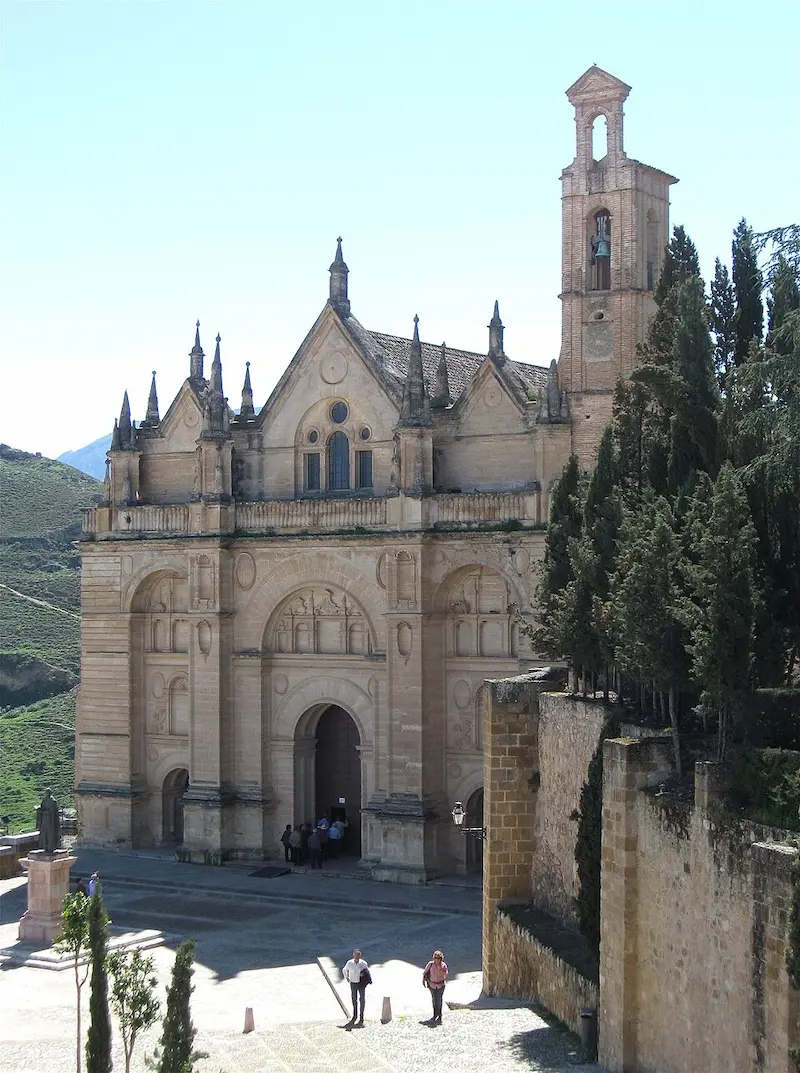
Right next to the Alcazaba, so they come one after the other. 4.3 out of 465 reviews.
Its value lies in the façade: is one of the earliest examples of Renaissance architecture in Andalusia, and this is evident from its façade, which bears more resemblance to an Italian cathedral than to an Andalusian church.
There are two things to look out for inside:
It’s practically empty inside. It is no longer used for worship and is preserved with almost no furnishings, so that The tour takes ten minutes. Several reviews express disappointment about this.
It works like this: It’s the façade, the ceiling and the carvings that draw you in, not a crowded interior.
And as you leave, the Arch of the Giants is just a few metres away, with the viewpoint overlooking the floodplain. It’s free and offers the best view in the area.
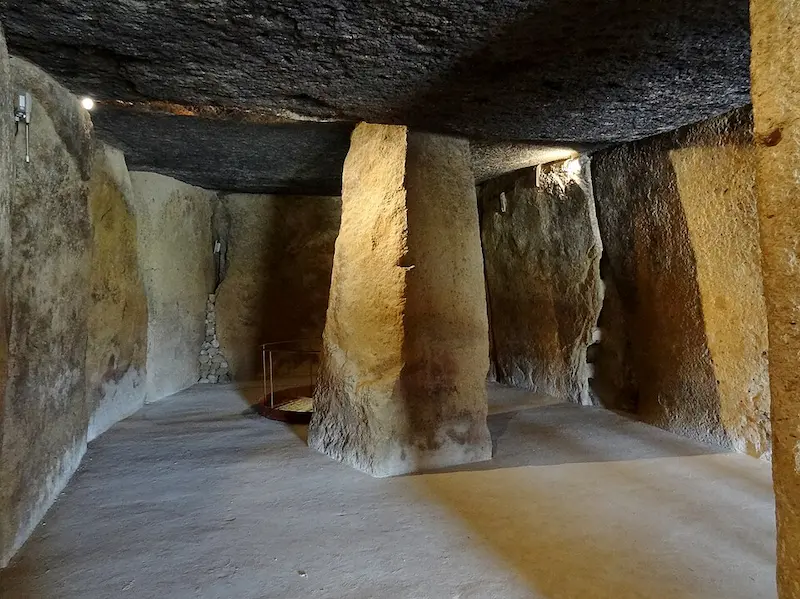
Carretera de Málaga, 5, on the outskirts. 4.5 out of 5. 4,458 reviews and free entry, including the museum.
There are three megalithic monuments:
And the scale of the figure: they date from around 3,700 BC. In other words, more than a thousand years before Stonehenge, and you walk straight in here.
That sets the tone for the whole day, and it’s the easiest mistake to make in Antequera: arriving at four in the afternoon only to find it closed.
Tip: ask for the video at reception before you go in. It explains how they were built, and that’s what the reviews praise most.
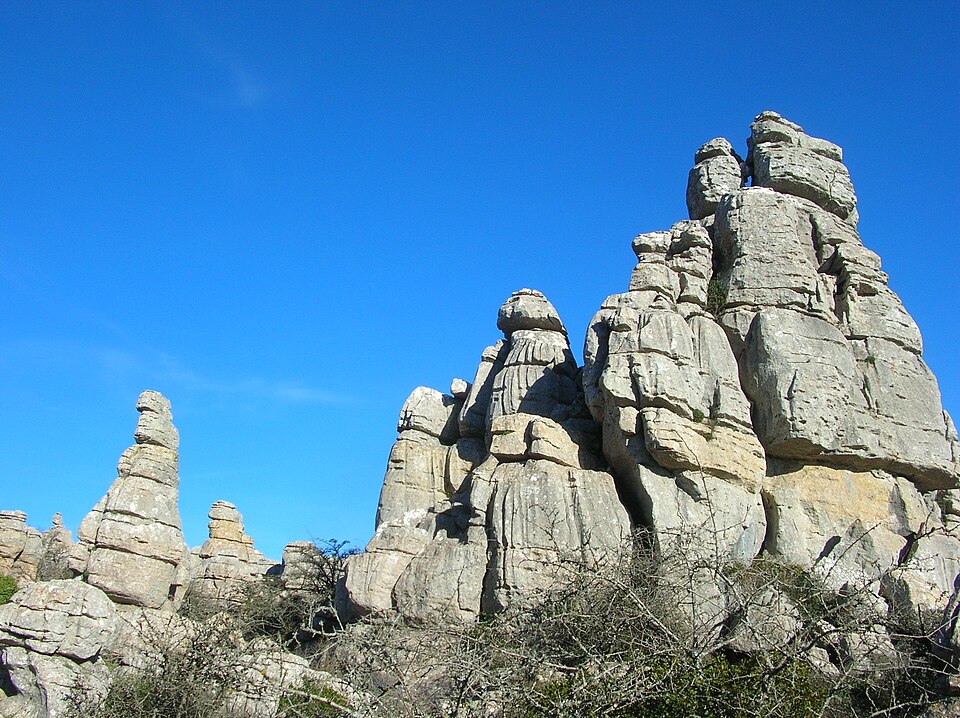
16 kilometres from the town centre, along the access road to Torcal Alto. The visitor centre is open from 9.30 am to 5.00 pm and admission is free. 4.6 out of 3,702 reviews.
It is a limestone karst landscape: blocks stacked in horizontal layers, as if someone had left piles of giant plates scattered across the hillside. It was formed under the sea millions of years ago.
And the viewpoint that hardly anyone mentions: Las Ventanillaswith Rating: 4.8 —the highest mark in the whole of Antequera—, is just a few metres from the car park and it is open to the public 24 hours a day.
If you don’t have the time or the stamina for the walk, that viewpoint alone makes the climb worthwhile. And at sunset, it’s spectacular.
There’s a restaurant in the visitor centre, offering good value for money. And you’ll see mountain goats on the rocks.
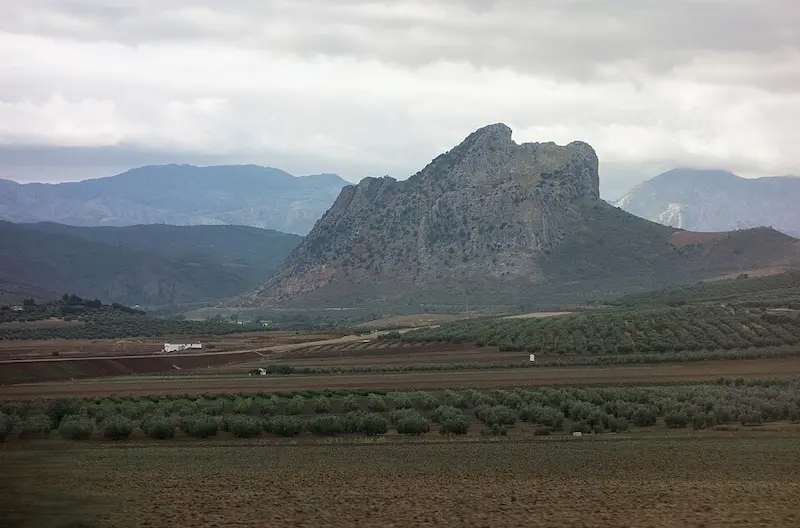
You don’t visit it: you look at it. And once you’ve seen it, you’ll never forget it.
It is a limestone outcrop which, when viewed from the right angle, forms the image of a human face lying down and looking up at the sky: the forehead, the nose, the chin. It can be seen best from the south, coming along the motorway from Málaga, and also from the Alcazaba.
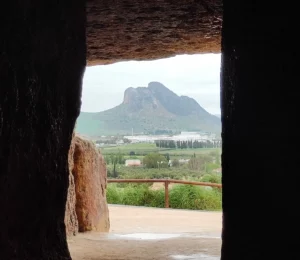
And it’s not just a geographical feature: It forms part of the site designated as a World Heritage Site, alongside the dolmens, because the Menga dolmen faces it. That is why UNESCO included the three elements as a single property.
The legend behind the name tells of two lovers who threw themselves from the top. The reason for its protection lies in the orientation of the dolmen.
Plaza del Coso Viejo, at the Palacio de Nájera. Rated 4.6 out of 874 reviews; open every day from 10.00 to 18.00; admission is free.
The must-see piece is the Ephebe of Antequera, a 1st-century Roman bronze statue which is one of the finest sculptures of its kind ever found in Spain. There is also a bust of Nero.
The building itself is worth a visit, with its inner courtyard and staircase.
When you go in, they ask which country you’re from, for statistical purposes. That’s all.
Antequera has 33 churches for a population of around 41,800. One for every 1,250 residents – a ratio that’s hard to come by.
And there is a specific explanation: Following the Christian conquest, the city remained as a crossroads leading to all the Andalusian capital cities. This location attracted religious orders, which began to establish themselves one after the other.
You don’t need to watch them all. You only have to walk through the city centre and look up: towers and bell towers appear on every corner.
Admission to the Church of San Juan de Dios is free, if you’d like to see the interior without paying.
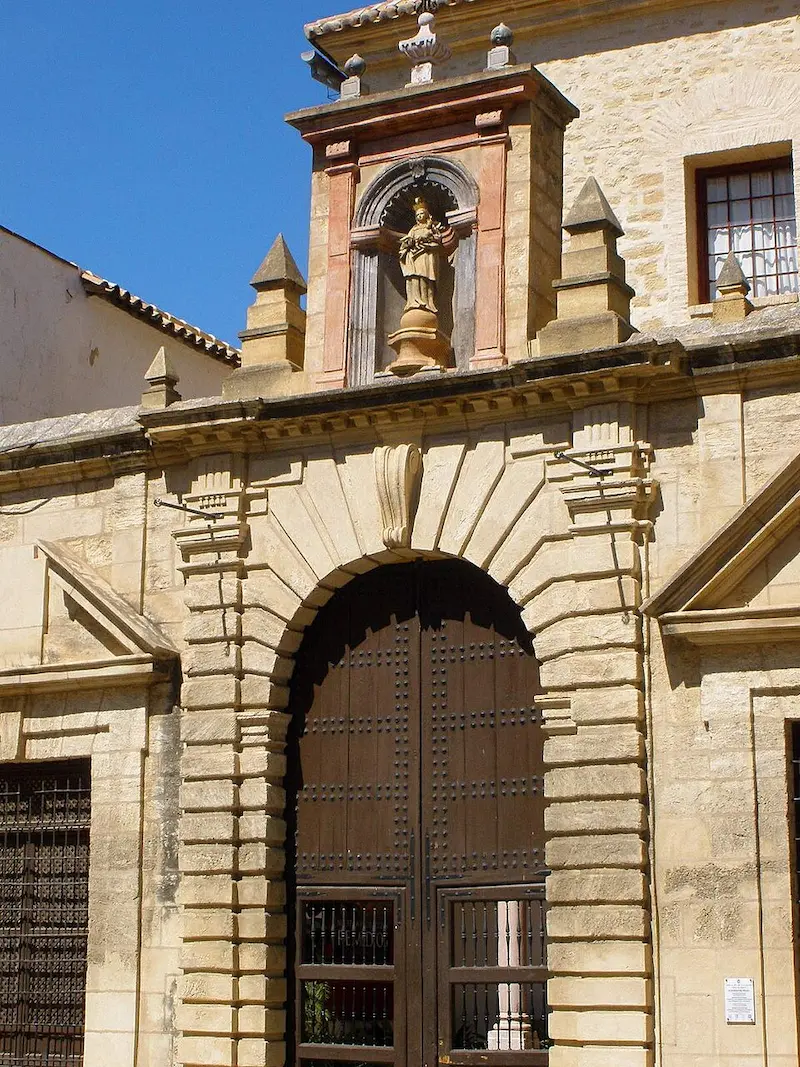
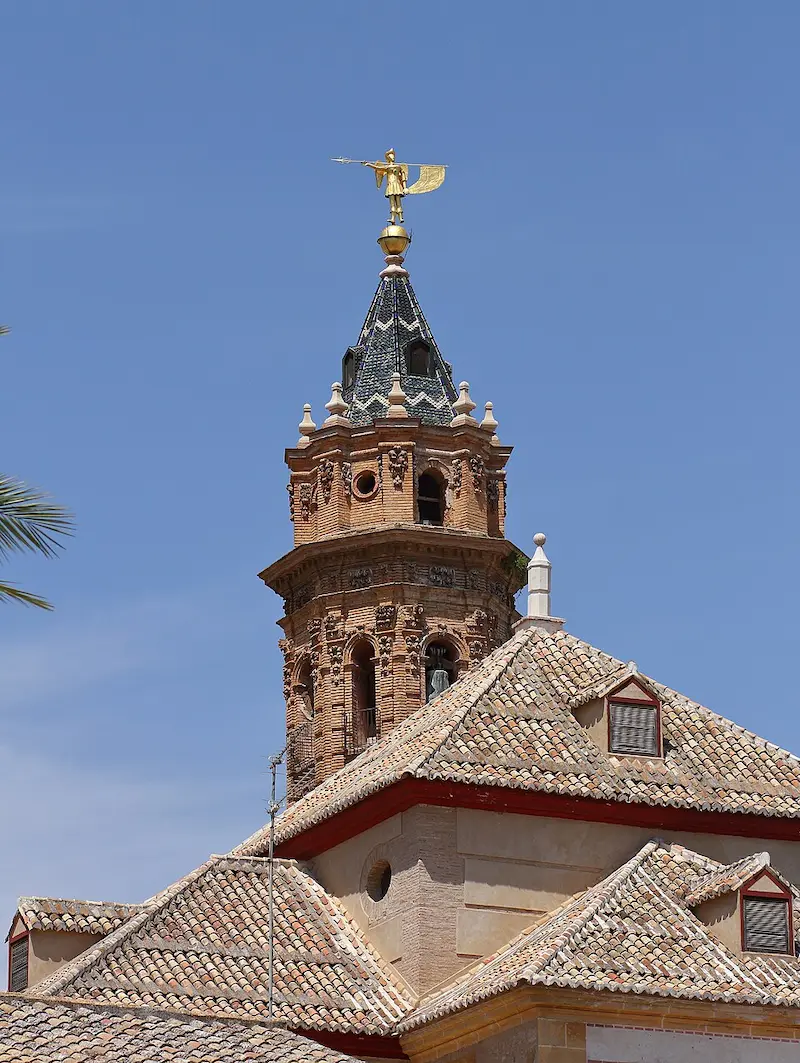
On top of the tower of the church of San Sebastián, there is a gilded figure turning in the wind: an archangel who acts as a weather vane and whom the people of Antequera call El Angelote.
It is the city’s popular symbol, and it is so well-known that it is used as a landmark. It can be seen from much of the city centre.
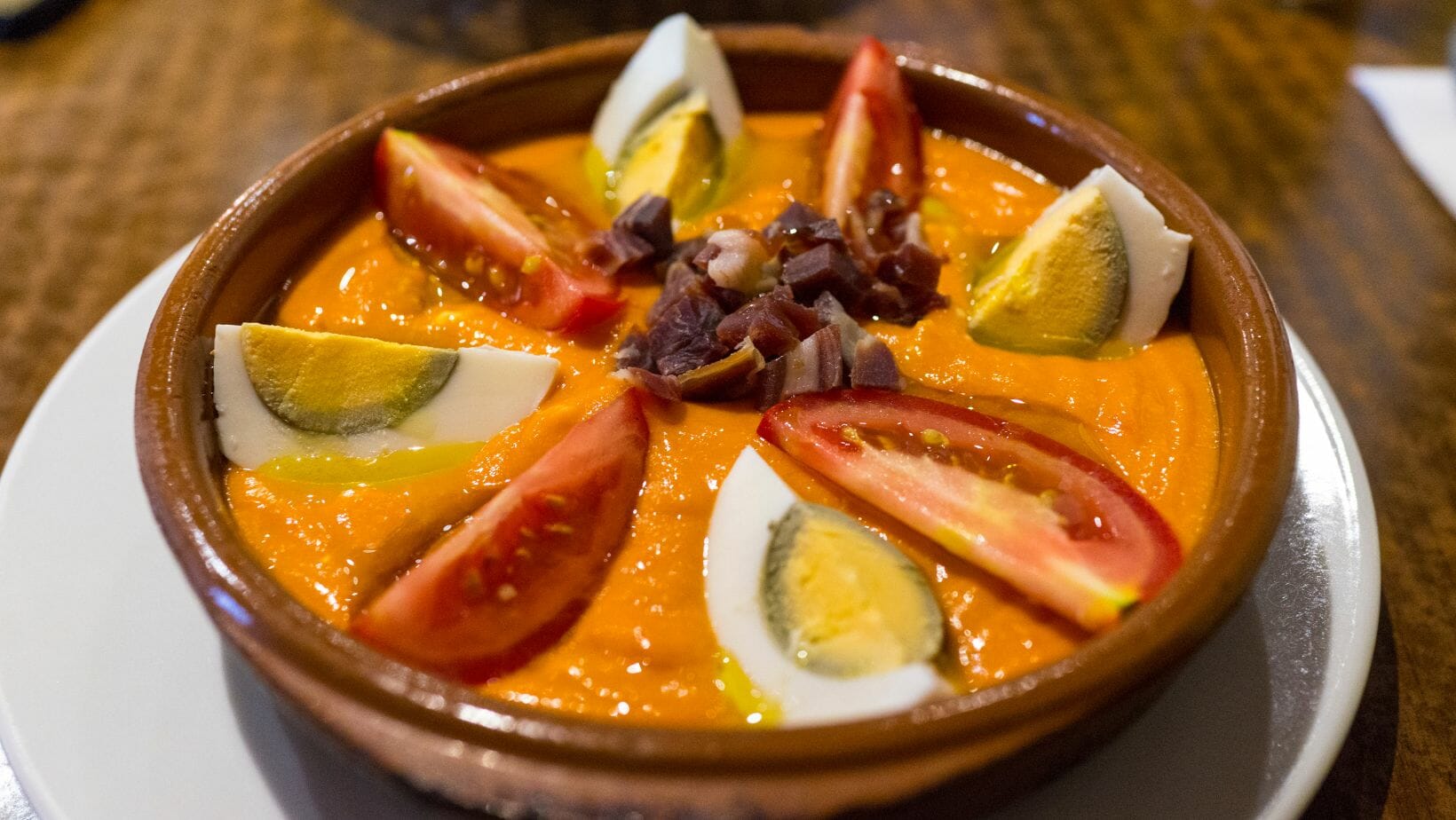
Two dishes with their own names:
And the dessert: on bienmesabe, made with almonds, a tradition handed down from the convents.
The split opening hours for the dolmens take precedence, so the itinerary is built around that:
If you’re going on a Monday, change your plans: The dolmens are closed, so we’ll spend the morning at the centre and the afternoon at El Torcal.
We are a local tour operator based in Málaga with over 50 years’ experience organising trips around Andalusia.
The problem with getting around Antequera without a car is connecting the three points: the town centre, the dolmens on the outskirts and El Torcal, 16 kilometres away. It’s not possible to see them all in a single day using public transport.
And to plan your visit in more detail: the most beautiful villages in Malaga y the Caminito del Rey, which is half an hour away and fits in well with a two-day break.
By car, it’s 45 kilometres along the A-45 towards Córdoba, with the turn-off just after Casabermeja – about forty minutes’ drive. By train, from María Zambrano it takes about thirty-two minutes, but you must get off at Antequera AV and not at Antequera-Santa Ana, which is 18 kilometres from the city centre. And by bus, with the Consorcio Metropolitano, it takes around an hour and costs less than seven euros, payable in cash on board.
At Antequera AV, also known as Antequera-Ciudad, which is one or two kilometres from the centre. The other station, Antequera-Santa Ana, is 18 kilometres away and requires a taxi or local bus, so the local tourist office itself recommends using only the former.
Visit the dolmens first thing in the morning, as they close at 1.30 pm; then the town centre with the Alcazaba, the Collegiate Church and the Arch of the Giants; and in the afternoon, El Torcal with its 45-minute ‘green route’ and the Las Ventanillas viewpoint. If your visit falls on a Monday, you’ll need to change the order, as the dolmens are closed on that day.
Nothing: entry is free, including the museum. It is open from Tuesday to Saturday at split times, from 9.00 am to 1.30 pm and from 7.00 pm to 9.30 pm, and on Sundays in the mornings only. It is closed on Mondays. These opening hours are the reason for the most common mistake in Antequera: arriving in the afternoon only to find it closed.
Yes, both the entrance and the visitor centre, which is open from 9.30 am to 5.00 pm every day. It is 16 kilometres from the town centre. It’s a good idea to take a jacket, as it’s cold and windy at altitudes of over a thousand metres even if it’s warm down below, and to wear walking boots, as the terrain is uneven and rocky.
The Las Ventanillas viewpoint, which has a rating of 4.8 – the highest in Antequera – is just a few metres from the car park and is open to the public at all times. It offers views of the karst landscape and the coast without the need to go on a walk, and is particularly recommended at sunset.
Because the site comprises three interrelated elements: the Menga and Viera dolmens, together with the Tholos of El Romeral, El Torcal and the Peña de los Enamorados. The Menga dolmen faces the Peña, and it is this relationship between human construction and natural features that UNESCO recognised when it designated the site.
Thirty-three, for a population of around 41,800: one for every 1,250 residents. The reason is that, following the Christian conquest, the city became a crossroads leading to all the Andalusian capitals, and this location attracted religious orders, which settled there one after the other.