The following live in or pass through the Strait of Gibraltar seven species of cetaceans. Four are there all year round and three only appear in season.
It’s no coincidence: Here, the Atlantic and the Mediterranean meet at fourteen kilometres wide, with opposing currents that generate an enormous amount of food. That is why UNESCO declared it Intercontinental Biosphere Reserve in 2006.
Here you have what can be seen, when and with what probability.
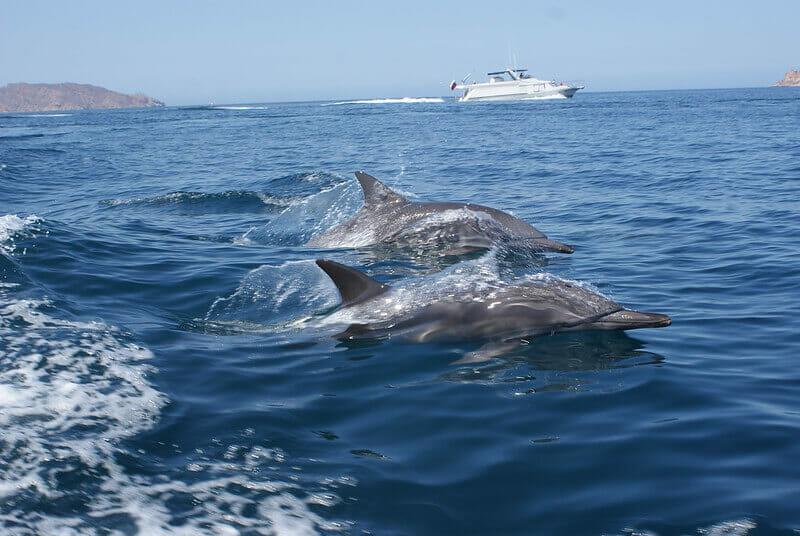
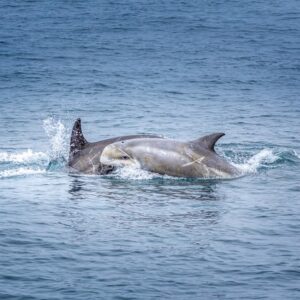
These four are residents, so they feature in the vast majority of outings, whatever the month:
The most abundant species in the Strait: it is estimated that more than a thousand people.
And here’s a surprising fact: despite being the most common here, It is classified as critically endangered in the Mediterranean, where it once became the most common dolphin but has now all but disappeared. The Strait is one of its last remaining habitats.
Another thousand or so specimens. It can be recognised by the blue and white stripes which run along their flanks, and because they move in large, fast-moving groups.
The largest of the three and the one that comes closest to the ships. A few 250 people. It’s the dolphin that everyone pictures in their mind, and the one that does the jumps.
They swim to more than 30 km/h and they dive to a depth of about 70 metres.
Despite its name, it isn’t a whale: it’s a dolphin, the second largest in the family. It has a sturdy body, a rounded head and is almost black in colour.
A few 250 copies in family groups that move slowly near the surface, making them easy to spot.
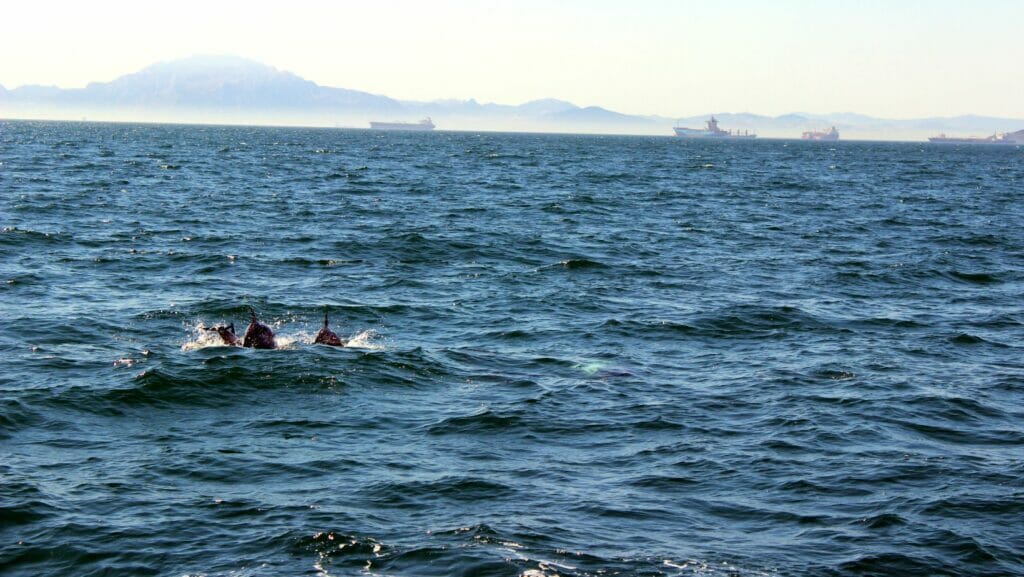
The population in the Strait is small: around fifty individuals.
And they’re coming for a specific reason: follow the bluefin tuna during their migration. That is why they gather in the height of summer, particularly July and August, and particularly towards the end. Outside that window, his presence is exceptional.
Technically The orca is also a dolphin: the eldest in the family.
The largest of the toothed cetaceans. It is semi-resident: it enters and leaves the Strait, following the cephalopods on which it feeds, diving to great depths.
How it is detected: between dives floats on the surface for several minutes recovering oxygen, which makes it visible from a distance. The Strait is recognised as a migration corridor for the species.
The second-largest whale on the planet, after the blue one. It is a long-distance migrant that crosses the Strait between the tropics and the Mediterranean.
It is the least likely sighting of the seven: it passes by without stopping.
It is often reported that humpback whales are spotted in the Strait. That’s not the case: it is not one of the seven species found in the Strait. The whale shown here is the common fin whale, which is something else entirely.
We need to distinguish between two things here, because they are constantly getting confused:
They are residents. They can be seen all year round, including winter.
But it is worth clarifying: What changes with the season is not whether they are there, but Is it possible to go sailing?. And that’s where summer wins hands down, because the sea is calmer.
There is a widespread belief that the best months are from November to January. That’s not true: the dolphins are just as active, but that’s when the sea is at its roughest and the most trips are cancelled.
Practical conclusion: from April to September The number of residents matches the immigration figures, and the sea is in better condition. That’s the right window.
The Levant is the enemy. Strong winds cause rough seas, making sightings difficult and leading to the cancellation of trips. Mornings tend to offer better conditions than in the afternoons.
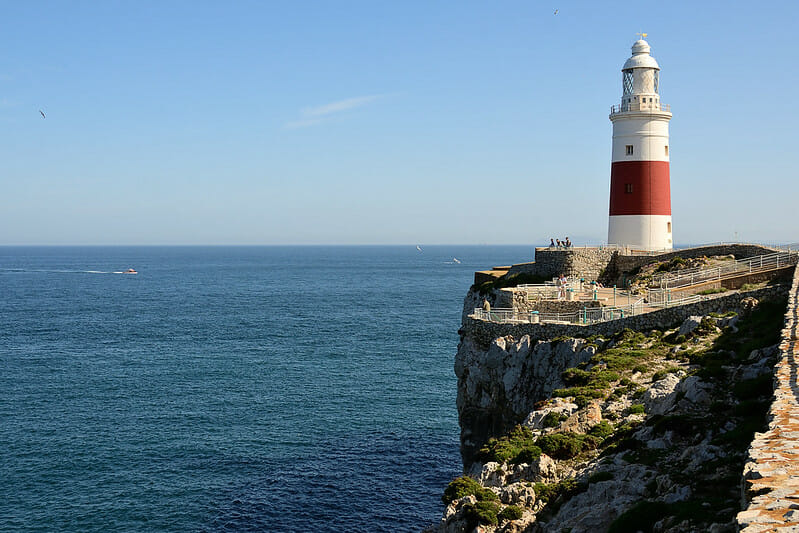
About 90 minutes’ sailing to the usual migration routes, with a crew who are familiar with the behaviour of each species and explain what they see.
What to bring:
And an honest word of warning: They are animals living in the wild. The dolphins appear on the vast majority of trips, but No sightings can be guaranteed, let alone that of migratory species.
When they appear, there is silence and calm. The crew marks out the distance; departures are timed so as not to disturb the animals.
There are two sides to the Strait, and they operate differently:
If you set off from Gibraltar, the journey takes an hour and a half and there’s plenty of time left As for the rest: the Nature Reserve, San Miguel Cave, the tunnels and the macaques.
Please note that the cable car is closed until 2027, so the climb takes longer than people reckon.
Everything at What to see on the Rock, the monkeys of Gibraltar y what to see in Gibraltar in one day.
We are a local tour operator based in Málaga with over 50 years’ experience organising trips around Andalusia. The excursion combines a boat trip and a visit to the Rock in a single day, with transport from Málaga and the Costa del Sol:
More about the region at Ten interesting facts about Gibraltar and in The Gibraltar Guide.
Seven species. Four are resident and can be seen all year round: the common dolphin, the striped dolphin, the bottlenose dolphin and the long-finned pilot whale. The other three are migratory or semi-resident and appear at specific times of year: the orca, the sperm whale and the fin whale. The confluence of Atlantic and Mediterranean waters in a stretch barely fourteen kilometres wide generates the abundance of food that explains this concentration.
The dolphins are resident and can be spotted at any time of year. What changes with the seasons is not their presence but the sailing conditions: in summer the sea is calmer and fewer trips are cancelled. There is a common belief that the best months are from November to January, but this is not entirely accurate: the dolphins are still there, although the sea conditions are considerably worse.
No. The humpback whale is not one of the seven species found in the Strait, although it is frequently mentioned. The whale that can actually be seen is the fin whale, the second-largest on the planet after the blue whale, which passes through the area during its migratory journeys and is the least likely to be spotted of all.
In the height of summer, mainly during July and August and particularly towards the end of this period, coinciding with the passage of the bluefin tuna on which they feed. The population in the Strait numbers around fifty individuals. Outside this period, their presence is rare. It is worth remembering that the orca is, technically speaking, the largest member of the dolphin family.
No, although its appearance might suggest otherwise and it is known in English as a pilot whale. It belongs to the dolphin family, of which it is the second-largest member. In the Strait, there are around 250 of them, which travel in family groups near the surface, making them one of the easiest cetaceans to spot.
No, because these are wild animals. Dolphins are seen on the vast majority of trips as they are resident, but no sighting can be guaranteed, and this is even less likely for migratory species. Sea conditions play a decisive role: an easterly wind stirs up swells, makes sightings difficult and can even lead to cancellations.