If you’re planning to visit the Roman Theatre in Málaga, want to know its opening hours or find out exactly where it is, here’s a handy summary: the site is situated right in the heart of the historic centre, on Calle Alcazabilla; it’s an open-air attraction and admission is free. Here’s a look at its history, what the Interpretation Centre has to offer and how to plan your visit.
The theatre was built in the 1st century AD and lay hidden underground for centuries until it was rediscovered in 1951, during building works near the Alcazaba. Today it occupies a unique spot in the city, right where Málaga preserves the traces of three overlapping cultures: Roman, Al-Andalus and Christian. If you’re planning your route around the city, you’ll want to include it in your itinerary. Things to see in Málaga to make the most of the proximity between the monuments.
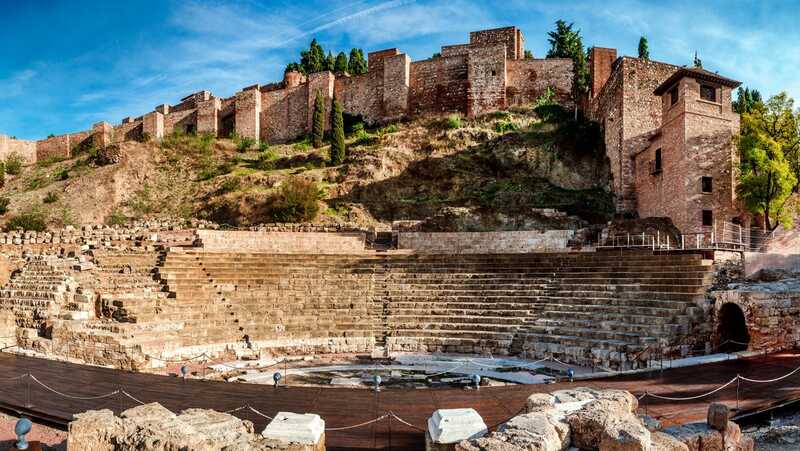
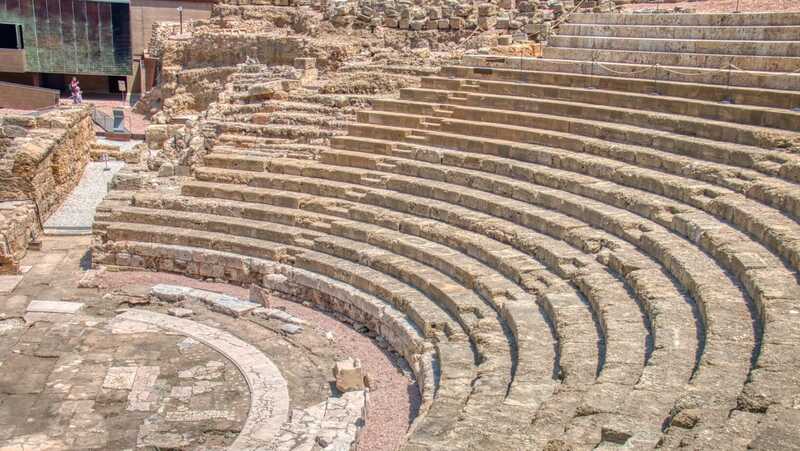
The Roman Theatre in Málaga was built during the reign of Emperor Augustus, in the 1st century AD, making use of the natural slope of the hillside on which the Alcazaba would later be built. This layout is typical of Roman theatres: the disclaimer The stands rest directly on the natural contours of the ground, rather than being supported by artificial structures as was the case at other venues across the Empire.
The building remained in use until around the 3rd century. It was subsequently abandoned as a venue for performances and, during the Byzantine and Al-Andalus periods, its materials were reused in other buildings. A large proportion of the theatre’s ashlars and columns were eventually incorporated into the Alcazaba itself, a clear example of how each civilisation reused what the previous one had left behind.
The site was part of the former Malacca, a city of Phoenician origin which, under Roman rule, acquired its own legal status. That legal framework was set out in the Lex Flavia Malacitana, the municipal law dating from the late 1st century which regulated the administrative life of the city and which is one of the most valuable epigraphic documents for understanding the functioning of Roman municipalities in Hispania. The theatre, as a major public space, was a central feature of that Roman Málaga.
After lying buried for centuries, the site was rediscovered in 1951 whilst work was being carried out in the gardens of the Casa de la Cultura, which occupied the site at the time. Subsequent excavations brought to light the seating area, the orchestra pit and part of the stage, and eventually led to the demolition of that building in order to restore the monument. Today, the theatre is listed as a publicly owned archaeological site.
Next to the theatre is the Roman Theatre Interpretation Centre, an indoor space that helps to put what you see in the open-air site into context. It is not a museum with extensive collections, but a facility designed to explain what the building was like, how a Roman theatre worked and what role it played in the life of the city.
Inside, panels, archaeological artefacts and audiovisual resources are combined. Of particular note are the replicas and interactive features that recreate the theatre’s original structure, as well as everyday objects from Roman Málaga, such as the garum —fish sauce, which was one of the region’s best-known commercial products—. A visit to the centre provides a better understanding of the tiers, the stage and the seating area reserved for spectators according to their social status.
Access to the Interpretation Centre is included in the tour of the site, so you can explore the exhibition first and then go outside to look at the theatre with a clearer idea of what you’re seeing.
The great advantage of Málaga’s Roman Theatre is that it can be viewed at any time from Calle Alcazabilla, as it is an open-air site and is not enclosed by walls. To access the inner grounds and the Interpretation Centre, however, you must observe the opening hours.
The site opens from Tuesday to Saturday, 10.00 am to 6.00 pm y Sundays and public holidays from 10.00 to 16.00, and it is closed on Mondays. As opening times may vary depending on the season or specific events, it is advisable to check the current opening times on the site’s official website before planning your visit.
At night, the theatre is lit up, offering a different perspective on the building even after the auditorium has closed.
The theatre is on Calle Alcazabilla, in the heart of the historic centre, just a few minutes’ walk from the Cathedral, Calle Larios and the area around Plaza de la Merced. As it is in a pedestrian zone, the easiest way to get there is on foot; if using public transport, the bus stops and the nearby metro and commuter rail stations in the city centre are just a short walk from the theatre.
The main attraction of the location is that the theatre shares the premises with the Alcazaba of Malaga, the Al-Andalus fortress that rises up just behind it. Visiting both in quick succession allows you to explore Roman and Muslim Málaga from a single spot, and from the top of the Alcazaba — or by climbing up to Gibralfaro Castle — you can enjoy some of the best views of the city and the harbour.
Thanks to its central location, the Roman Theatre is a good place to start or finish a walking tour of the old town, as it can be easily combined with the other nearby monuments without having to walk long distances.
The Roman Theatre site can be seen from the street at any time, as it is an open-air site next to the Alcazaba. The Interpretation Centre is open from Tuesday to Saturday from 10.00 to 18.00 and on Sundays and public holidays from 10.00 to 16.00; it is closed on Mondays. It is advisable to check the current opening hours on the site’s official website before visiting, as they may vary depending on the season.
Entry to the Roman Theatre in Málaga and its Visitor Centre is free. You do not need to book a ticket to enter the site on a self-guided visit, although for large groups or guided tours it is advisable to check the conditions in advance.
The Roman Theatre in Málaga was built in the 1st century AD, during the reign of Emperor Augustus, and remained in use until around the 3rd century. It is one of the oldest surviving remains of the ancient Roman city of Malaca and was rediscovered in 1951.
If you’d like to extend your route beyond the historic centre, you can combine your visit with one of the excursions from Malaga and explore other parts of the province on the same trip.