Holy Week in Málaga is one of Spain’s most important celebrations and has been declared a Festival of International Tourist Interest. It runs from Palm Sunday to Easter Sunday – eight days during which the religious brotherhoods take their floats out onto the streets and carry out their penitential processions along the official route through the historic centre. If you’ve never experienced it before, this guide explains when it takes place, where the processions go, which ones you shouldn’t miss and how to organise yourself to enjoy it without any hassle.
Málaga is a great base for those few days: as well as Holy Week, the city and the province are close by, so you can combine the processions with sightseeing. If you arrive a few days early or stay on afterwards, you can make the most of the opportunity to do some of the excursions from Malaga and round off your trip with a visit to the coast, the countryside or the nearby villages.
The date varies, as it depends on the lunar calendar and changes every year. The Holy Week in Málaga 2027 will be held from Sunday 21 March, Palm Sunday, to Sunday 28 March, Easter Sunday. Maundy Thursday falls on 25 March and Good Friday on 26 March. It is advisable to make a note of these dates before organising your trip or booking accommodation.
Not every day is equally intense. Palm Sunday kicks off the week, and the central days – from Holy Monday to Good Friday – account for the bulk of the processions. Holy Thursday and Good Friday see the largest crowds, with the city practically spilling out onto the streets. Holy Saturday is a more subdued affair, whilst Easter Sunday brings the celebrations to a close on a festive note. If you’re only staying for a few days, focus on the period from Holy Wednesday to Good Friday, which features the best-known processions.
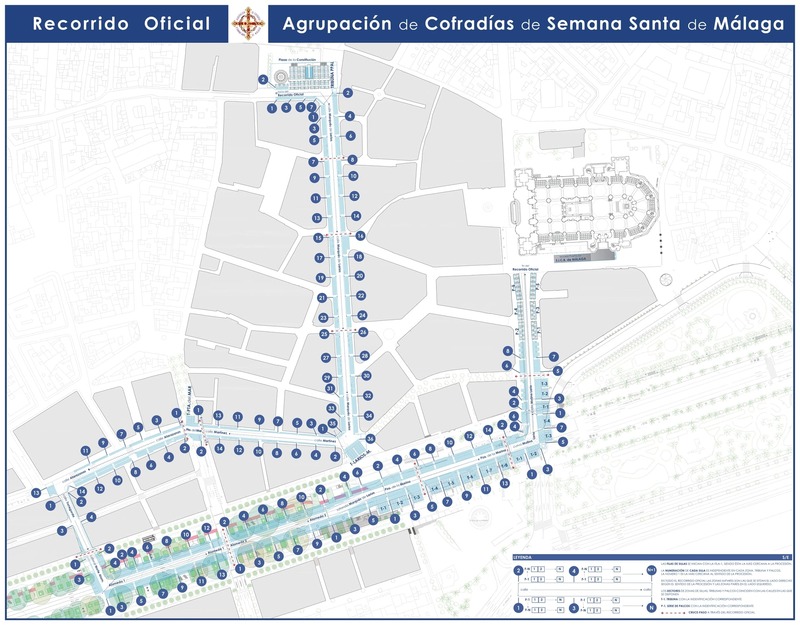
Each brotherhood sets off from its headquarters or church and heads for the official route – the common itinerary that all of them follow before returning to their church. In Málaga, the route is as follows:
For first-time visitors, finding a spot along the official route is the most practical option: from a single spot, you can watch several brotherhoods pass by throughout the afternoon and evening, without having to chase after each procession through its own neighbourhood. Calle Larios and the Alameda are the most popular spots, so make sure you arrive early if you want a good spot.
Part of the route features paid grandstands and seats, whilst the rest is open to the public. If you don’t want to book a seat, the best spots for watching the floats whilst standing are usually the wide sections of the Alameda Principal and the approaches to the Plaza de la Constitución, where there is more space. And if you’d rather avoid the crowds, it’s well worth seeking out the processions in their own neighbourhoods, off the usual route: you can watch them in a much more relaxed atmosphere. Bear in mind that the city centre is closed to traffic during the processions, so the easiest way to get around is on foot, and you should allow plenty of time for your journey.
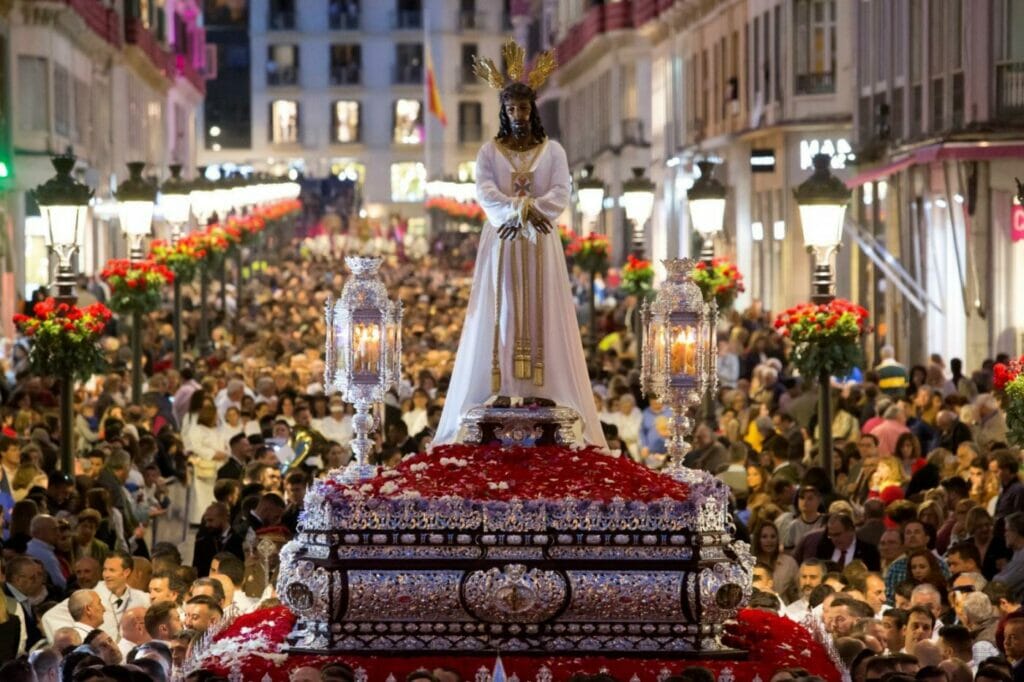
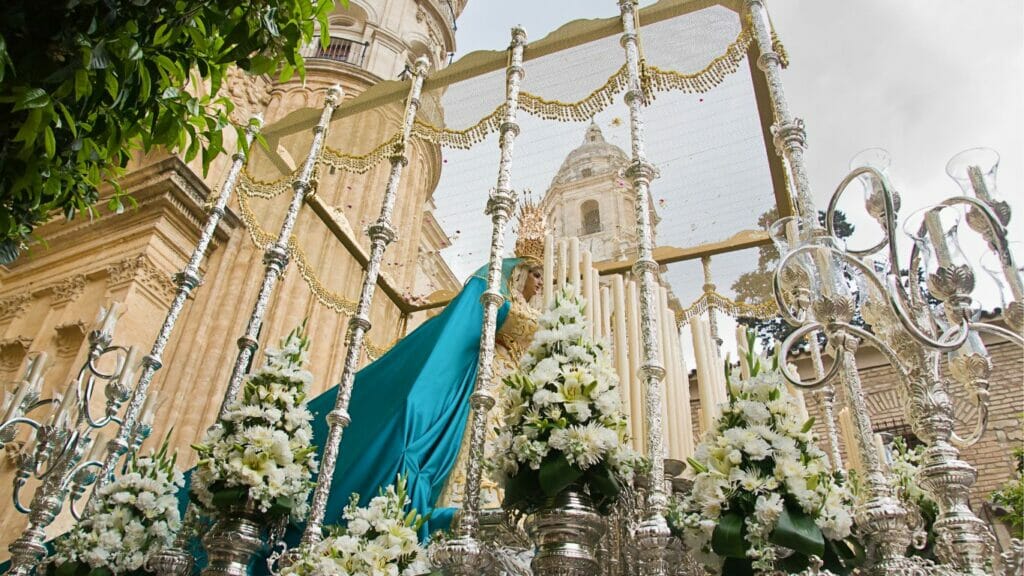
Holy Week in Málaga has a character all of its own: huge floats, carried by hundreds of men and women of the throne, and a very lively street atmosphere. There are processions that have become unmissable due to the devotion they inspire, their music or their route. Here is the day-by-day schedule, listing the brotherhoods taking part and a tip for each day.
Religious brotherhoods: La Pollinica, The United Ones, Sweet Name, Greeting, Humility and Patience, Humility, Health, Orchard and Captivity.
Tip: Get some palm fronds and olive branches to watch the Pollinica at midday – the first brotherhood to set out during the whole of Malaga’s Holy Week. It’s a good day to get a feel for the atmosphere.
Religious brotherhoods: Crucifixion, Passion, Gypsies, Dolores del Puente, The Captive and The Students.
Tip: see the Captive, the Lord of Málaga, crosses the Aurora Bridge. It is one of the most famous moments of the week because, due to the movement of the throne, it gives the impression that the statue is walking. The crowd following it through the Trinidad neighbourhood is enormous.
Religious brotherhoods: El Rocío, Las Penas, Nueva Esperanza, Humillación and Estrella, Rescate and La Sentencia.
Tip: Take a look at the spectacular mantle of flowers carried by the Virgin of Sorrows.
Religious brotherhoods: Mediadora, Salesianos, Fusionadas, Paloma, Rico, Sangre and La Expiración.
Tip: on Rico It upholds the tradition of freeing one prisoner each year, an event that attracts huge crowds. And if you stay until the end, watching the sunrise during the procession of the Cristo de la Expiración is a unique experience.
Religious brotherhoods: La Cena, Santa Cruz, Viñeros, Vera Cruz, Zamarrilla, Mena, Misericordia and La Esperanza.
Tip: It is one of the highlights of the week. Don’t miss the Legion’s arrival to carry the Cristo de la Buena Muerte statue, in the morning at the harbour, or the Mena procession in the afternoon.
Religious brotherhoods: The Calvary, The Descent from the Cross, The Sorrows of St John, Love, The Transfer, The Pietà and The Tomb.
Tip: a more subdued and solemn day. Watching the Servitas brotherhood pass by in the darkness, at any point along its route, is one of the most moving moments.
A quiet day, marked by the Holy Procession and a more subdued atmosphere. A good time to take a stroll through the city centre without the crowds of the big festival days.
Closed for the public holiday on Risen, the last procession of the week. It sets off from the church of San Julián at around 10.15 am and ends at around 2.45 pm, so it is the only one that takes place in broad daylight.
The final timetables and routes are published each year by the Association of Holy Week Brotherhoods of Málaga, which is the organisation responsible for coordinating the official route. It is advisable to check these before setting off, as they vary from one year to the next.
Check the procession timetables and day-by-day routes for each year.
If there is one image that is associated with Holy Week in Málaga, it is that of the legionnaires accompanying the Christ of the Good Death, organised by the Mena brotherhood. The event takes place on Holy Thursday morning and attracts thousands of people.
Start with the the Legion’s landing at Pier 2 of the port, at around 10.00. Half an hour later, the procession reaches Fray Alonso de Santo Tomás Square, and from there the Santísimo Cristo de la Buena Muerte y Ánimas is carried to its processional throne in the church of Santo Domingo. In some sections, the soldiers carry it on their shoulders. The Legion and the Navy take part in the procession, with troops, a marching band and a bugle band, due to the brotherhood’s links with both institutions.
With the Christ figure in their arms, the legionnaires sing Death’s Boyfriend, the hymn that marks the most moving moment of the morning. In the afternoon, the Mena brotherhood holds its procession through the town centre, escorted by the Legion.
Space on the quay is limited and many people arrive well in advance, so it’s best to get there early. If you can’t get a front-row spot, the afternoon procession through the city centre is another good opportunity to see the legionnaires marching alongside the throne. It’s a moment that blends the religious and the military, and for many visitors it encapsulates the unique character of Malaga’s Holy Week.
Although the processions set the agenda, there is life beyond the floats. Between one procession and the next, you can make the most of the city and its surroundings:
The key is to organise your day around the times of the processions you want to see and leave the mornings for other activities, as most of the action takes place from the afternoon until the early hours of the morning. It’s a good idea to wear comfortable shoes, as you’ll end up walking a lot, and to take something warm with you: March nights can still be chilly. If you’re travelling with children, look for the less crowded sections of the official route so you can enjoy it at a more leisurely pace.
As for accommodation, bear in mind that this is the busiest week of the year in the city, so booking well in advance makes all the difference in terms of both availability and location. Staying in or near the city centre will save you time travelling on the days when traffic is at its worst.
Holy Week in Málaga has its roots in the religious brotherhoods and confraternities that emerged following the Christian conquest of the city in 1487, and its processions have been documented since the 16th century. These brotherhoods were originally formed as a means of religious organisation for the various social groups of the time and, over time, became a fundamental part of the city’s cultural and social life.
Coordination of all these events is currently the responsibility of the Association of Holy Week Brotherhoods of Málaga, the official body that organises the official procession route and safeguards the tradition. The celebration has been designated a Festival of International Tourist Interest and has been a source of inspiration for numerous literary and artistic works.
Their most distinctive feature is the thrones: large, heavy structures which, unlike the floats in Seville, are carried on the shoulders and in full view by hundreds of men and women known as ‘throne bearers’, rather than by ‘costaleros’ hidden beneath the structure. Every Holy Week, the promotional poster is also unveiled; this artwork is renewed annually and marks the symbolic start of the events leading up to the big week.
Throughout the year, the city’s festival calendar is rounded off with other celebrations that are deeply rooted in local tradition, such as the Malaga Fair in August. If you’d like to find out more, take a look at Other festivals and traditions in Málaga to plan your visit at any time of year.
Holy Week in Málaga 2027 will be celebrated from Sunday 21 March, Palm Sunday, to Sunday 28 March, Easter Sunday. Maundy Thursday falls on 25 March and Good Friday on 26 March. During those eight days, the religious brotherhoods carry out their penitential processions along the official route through the historic centre.
It starts at Plaza de la Constitución, heads down Calle Marqués de Larios, continues along Calle Martínez, past the Central Market of Atarazanas and Torregorda, carries on along the Alameda Principal and Plaza de la Marina, and ends at Calle Molina Lario, at the foot of the Cathedral. All the religious brotherhoods follow this shared route, making it the best place to see several processional floats in one spot.
Among the most popular are the Pollinica procession on Palm Sunday, the Cautivo procession on Holy Monday, the Rico procession on Holy Wednesday and the Mena procession with its escort of legionnaires on Holy Thursday. On Good Friday, the Sepulcro and the Servitas stand out, whilst the Resucitado brings the processions to a close on Easter Sunday. Each day features key brotherhoods, so it’s a good idea to check the timetable before setting out.
The legionnaires march on Maundy Thursday, when they accompany the ‘Cristo de la Buena Muerte’ from the Mena brotherhood. The Legion disembarks in the morning at Pier 2 of the port, at around 10.00, and from Plaza Fray Alonso de Santo Tomás they carry the statue to the church of Santo Domingo, singing ‘El novio de la muerte’.
No. In Málaga, the floats are carried by what are known as ‘throne bearers’ – men and women who remain in full view and carry the structure on their shoulders. The ‘costaleros’, who are hidden beneath the float, are a distinctive feature of Seville’s Holy Week. This is one of the most obvious differences between the two celebrations.