The Paseo de la Farola is the section linking the port of Málaga with La Malagueta, running along the mouth of the river. It’s a short, flat walk that takes ten minutes.
And it is chaired by the city’s most beloved lighthouse, which has a much better story than it first appears.
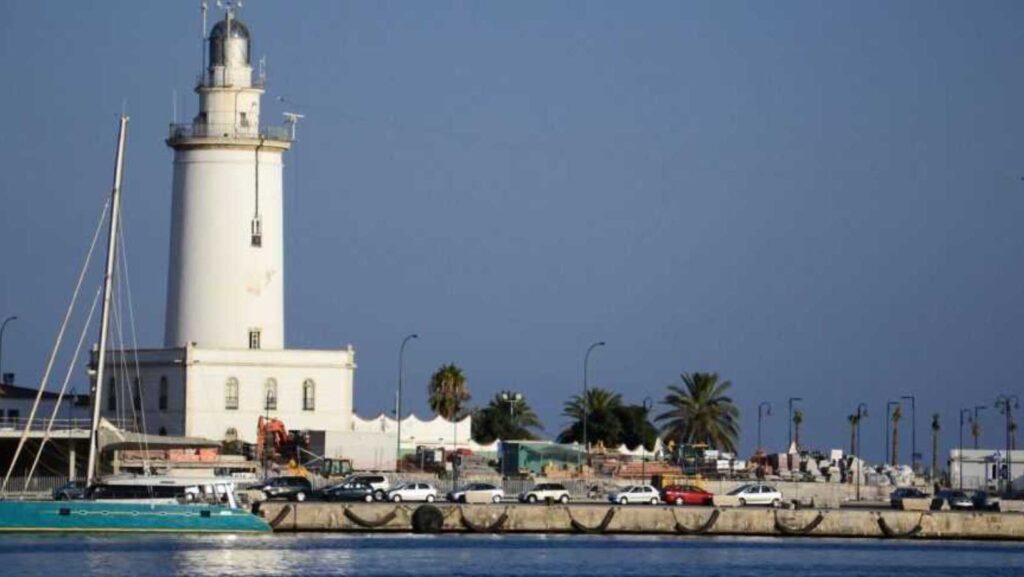
It is the only lighthouse on the peninsula with a female name. There is only one other in Spain: the Farola del Mar, in Tenerife.
Where does the feminine form come from: The popular explanation in Málaga points to its broad, stocky shape, which is very different from the slender tower one imagines when thinking of a lighthouse.
It is the sixth oldest lighthouse in Spain which is still in service.
Two figures are read out, and both are correct: The tower is 22 metres high, with 10 as the base, but its focal height is 38 metres above sea level, which is the figure used by sailors. Its light can be seen up to 25 nautical miles away.
A cultural note: has inspired Picasso and poets such as Vicente Aleixandre y Jorge Guillén.
And a practical clarification: You cannot visit the interior. It is an active lighthouse managed by the Port Authority. It can be seen from the outside, and the promenade around it is open to the public.
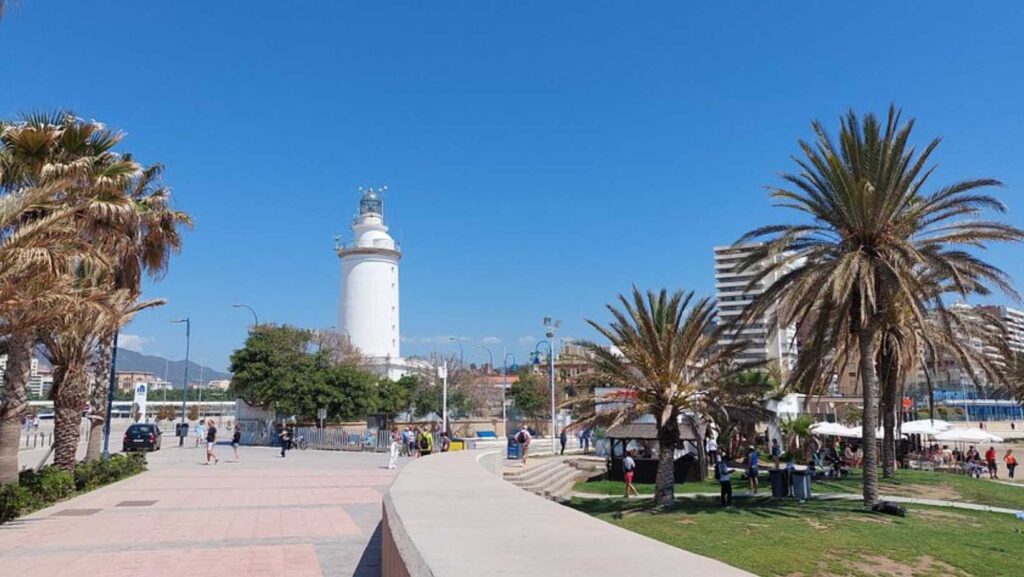
The walk connects three different things within a very small area:
It’s a good spot for watching the boats come in, particularly the cruise ships, which pass by at close quarters.
Other spots to watch the sunset, in the best sunsets in Málaga.
Walking from the city centre, which makes sense: from the Cathedral or Larios it’s about ten minutes crossing the Málaga Park towards the sea.
By bus, several EMT bus routes stop near the port and La Malagueta. And the station María Zambrano and the cruise terminal are nearby.
It’s best not to go by car: There is heavy traffic in the area and on-street parking is limited. Please use the car parks on Paseo del Parque.
It forms the link between the centre and the coast, so it fits into any itinerary:
All organised in The 8 must-see monuments, and to see it from above, the viewpoints of Málaga.
And it’s completely free: more free plans at free things to do in Málaga.
We are a local tour operator based in Málaga with over 50 years’ experience organising trips around Andalusia. If you’d like to explore both the city and the surrounding countryside:
You’ve got the city in What to see in Málaga in three days, the catalogue at excursions and destiny in The Malaga Guide.
It is the only lighthouse on the peninsula with a feminine name, and there is only one other in Spain: the Farola del Mar in Tenerife. According to popular local legend in Málaga, the feminine name is attributed to its shape – broad and stocky – which is very different from the slender tower usually associated with a lighthouse. The name eventually came to be applied to the entire promenade.
The works were completed on 30 May 1817, during the reign of Ferdinand VII, under the supervision of the Navy engineer Joaquín María Pery y Guzmán, who was also director of the Port of Málaga. It was built using stone quarried from Mount Gibralfaro and replaced a simple wooden lantern that had previously served as a lighthouse.
Two figures are commonly quoted, and both are correct: the tower is 22 metres high, with a base of 10 metres, whilst its focal height is 38 metres above sea level, which is the reference point for navigation. Its light reaches 25 nautical miles and it is the sixth oldest lighthouse in Spain still in service.
No. It is a working lighthouse managed by the Port Authority, and the interior is not normally open to the public. However, you can walk around it and take photographs without restriction, as the Joaquín María Pery roundabout and the promenade surrounding it are freely accessible.
On 28 August 1936, it was switched off on the orders of the Naval Command, as its silhouette served as a reference point for enemy artillery and aircraft. It was also painted earth-coloured to camouflage it. It had previously survived the 1884 earthquake, which rendered its mechanisms inoperable and necessitated a major refurbishment in 1885.
The route connects Muelle Uno, with its shops, restaurants and the Centre Pompidou beneath the colourful Cube; the Farola itself, at the Joaquín María Pery roundabout, which serves as a viewpoint overlooking the harbour entrance; and Malagueta Beach, the city’s most central beach. It is also a good spot for watching cruise ships come in.