Eight things about the Alhambra that hardly anyone watches, and which can make a difference to your visit if you know about them in advance.
Let’s start with the most surprising one: There are two museums inside, and they’re free.
They are both at the Palace of Charles V, and here’s what almost nobody knows: Entry to the palace, its courtyard and the Alhambra Museum is free of charge. There’s no need to buy a ticket to enter the venue.
If you’ve got a bit of spare time, or if you’re heading to the venue without a ticket, it’s well worth a visit.
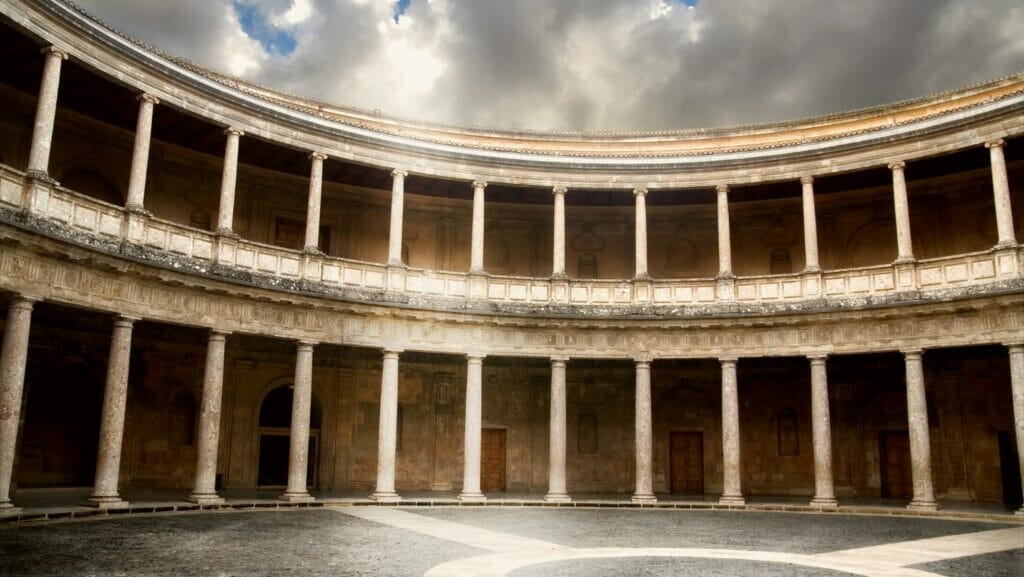
This story is one of the best about the monument. Charles V had a Renaissance palace built here, and commissioned the plans from Pedro Machuca, who had studied in Rome.
The timeline, which is a magnificent mess:
Four and a quarter centuries out in the open. And it’s still not quite finished: Only the south and west façades are fully decorated, and the interior sculpture scheme was never realised.
Take a look at this – it’s an extraordinary design detail. Machuca divided the palace into two halves along an imaginary diagonal:
Each half had its own staircase, and the two they all gathered right in the chapel: the place where the couple met. Architecture as a metaphor for marriage.
The data: square of 63 metres on each side and 17.40 metres high, with a a circular courtyard measuring 30 metres surrounded by 32 Doric columns. It was the first circular courtyard in a European royal palace.
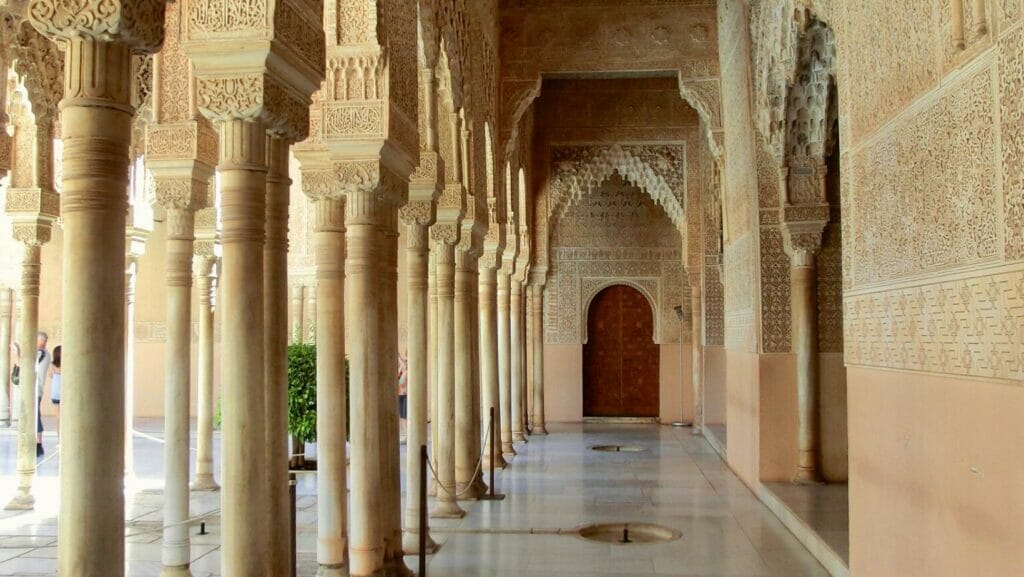
They shared the same building but never saw each other. The Alhambra had separate routes depending on who you were:
And this explains something that is puzzling when you visit: those corridors that seem absurd, the doors set at odd angles, the strange changes in level. They aren’t just whims: they were there to ensure that no one crossed paths with the wrong person.
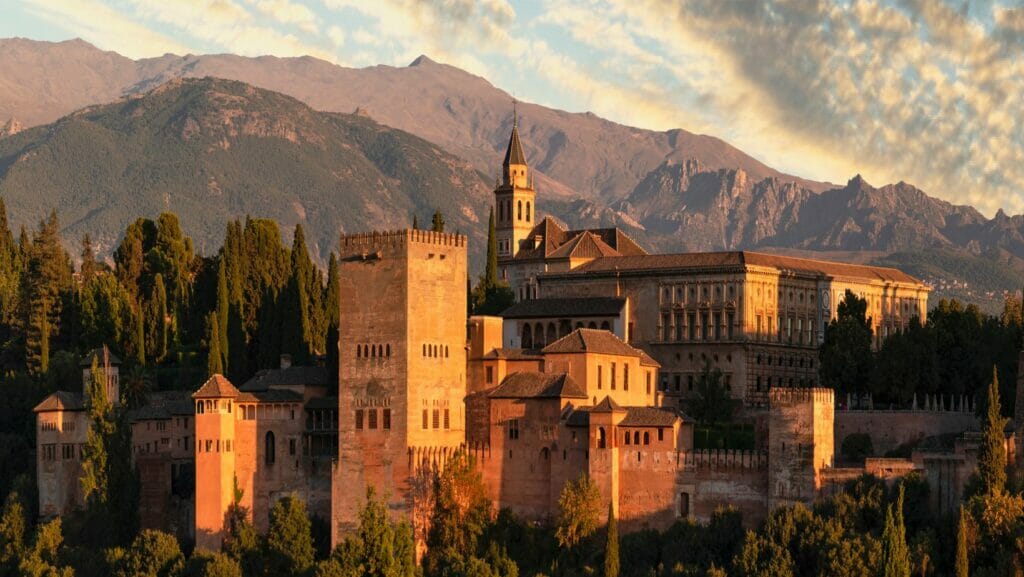
This is told as a legend, but it isn’t one. The assembly is oriented in such a way that You can tell the time by the shadows in the rooms.
The key moment is midday: at around midday, The Alhambra is split in two, half in the sun and half in the shade. Some people describe it as the world’s largest sundial.
It’s not folklore: it’s design, and is recognised as an astronomical instrument.
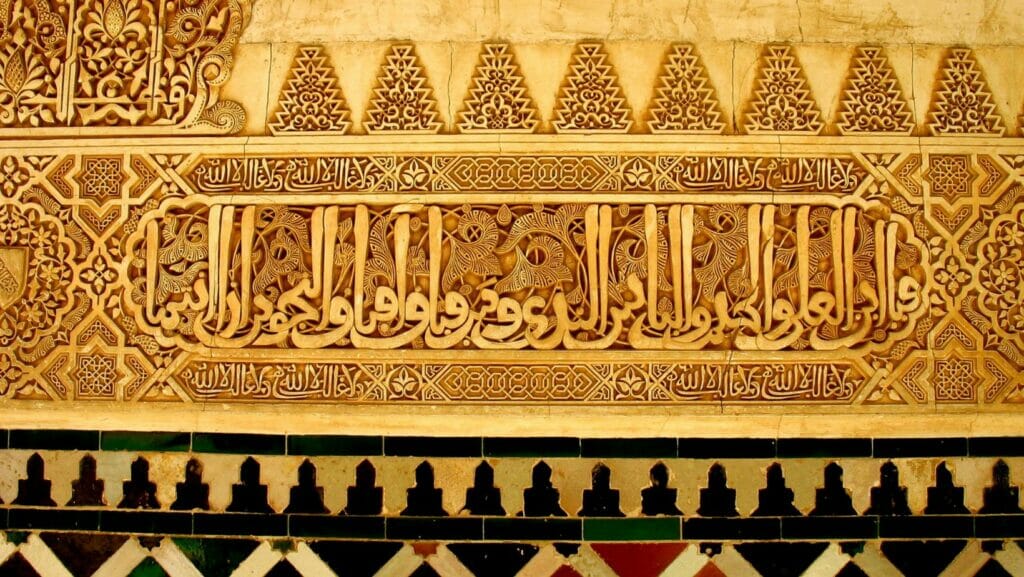
What you think is a drawing is actually Arabic text: verses from the Qur’an, blessings and poems by the court poets, particularly from Ibn Zamrak.
And there are venues that describe themselves as follows: Some of the verses refer to the very space in which they are inscribed, so the building is presented to visitors in writing.
The motto repeated thousands of times and the poems, in The inscriptions of the Alhambra.
The Tower of the Princesses, on the ramparts, it looks like just another watchtower. Inside, it’s a different story: a small palace with a central hall and rooms decorated around it.
And its name comes from a legend by Irving: the three princesses — Zayda, Zoraida and Zorahaida — who had been locked up there by their father. We tell the story in The Legends of the Alhambra.
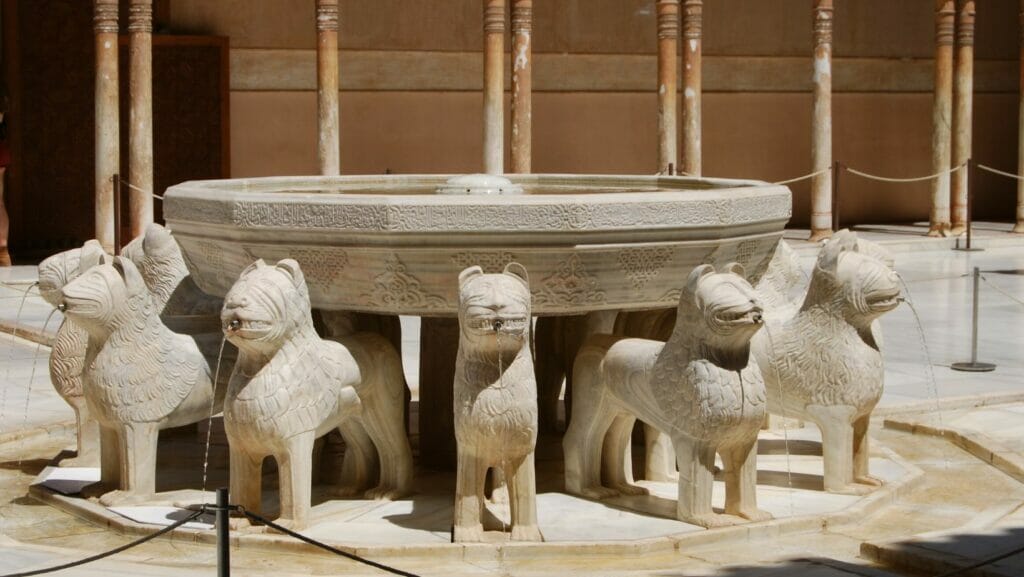
They look like twelve copies, but they aren’t. They differ in their faces, jaws, coats, tails, and even in size and weight. It is believed that they were carved a number of different artists.
A fun game to play with children: Spotting the differences keeps them engaged whilst looking at the monument’s most famous image.
As for what they symbolise, be careful what you read. Various theories are circulating — the zodiac, the twelve tribes of Israel, the four rivers of paradise — but none of them have been proven. The one that has the most support today is the simplest one: they are the guardians of the sultan’s power, in keeping with the poem written on them.
The details can be found at Interesting facts about the Patio de los Leones y the fountains of the Alhambra.
Alhambra comes from al-Hamra, «La Roja», whose full name is al-Qal’a al-hamra, «the red castle». As for the reason, there is three explanations and none of them are closed:
And here’s a fact that takes you by surprise: Some people maintain that During the Nasrid period, it was whitewashed. The red we see would have appeared later.
To explain it to the little ones, The story of the Alhambra for children.
We are a local tour operator based in Málaga with over 50 years’ experience organising trips around Andalusia. Tickets for the Alhambra are the hardest to get on your own:
Before you go, How to visit the Alhambra. And for the rest of the day, What to see in Granada y where to eat.
Yes. Both the Alhambra Museum, on the ground floor of the Palace of Charles V, and access to the palace itself and its circular courtyard are free of charge and do not require a ticket for the historic site. On the upper floor is the Granada Museum of Fine Arts, the city’s most important art gallery.
Work began in 1533 and the building remained roofless until 1958 – that is, for more than four centuries. Work was interrupted for fifteen years due to the Moorish rebellion of 1568, was abandoned completely in 1637 and did not resume until 1923, under Leopoldo Torres Balbás. It remains unfinished to this day: only the south and west façades are fully decorated, and the interior sculptural programme was never carried out.
It is a work of the Classical Renaissance based on the shapes of the square and the circle, through which Pedro Machuca sought to evoke Imperial Rome. It was the first circular courtyard in a European royal palace: it measures 30 metres in diameter and is surrounded by 32 Doric columns, set within a square building with sides measuring 63 metres.
Alhambra comes from the Arabic al-Hamra, «the red one», from the full name al-Qal’a al-hamra, «the red castle». There are three unresolved explanations: the reddish hue of its earth and lime walls, the nickname of its founder Muhammad I ibn al-Ahmar, «the Red», and the tradition that it was built at night and, by torchlight, appeared red from a distance. Some even maintain that during the Nasrid period it was whitewashed.
This has not been proven. The zodiac, the twelve tribes of Israel and the four rivers of paradise have all been suggested, but no hypothesis has conclusive support. The most widely accepted interpretation is that they represent guardians of the sultan’s power, which is consistent with the poem by Ibn Zamrak inscribed on the fountain’s basin.
Yes. The complex had separate routes: the court route, reserved for the sultan and his family; the route for scribes and administrators leading to the official quarters; and the route for the service staff. This layout explains the many corridors, angled doors and changes in level that seem baffling today, but which actually served to prevent different groups from crossing paths.