In Córdoba, you can see much of what defines the city without paying an entrance fee. The historic centre is an open-air museum: the streets of the Jewish Quarter, the squares, the Roman Bridge and most of the courtyards can be explored freely, and several monuments offer free entry at specific times. If you’d like to organise a day out focused on what doesn’t cost a penny, this guide brings together eight ideas for seeing Córdoba for free.
Much of Córdoba’s appeal lies in its outdoor spaces: façades, courtyards and hidden corners that are best enjoyed whilst strolling around. Added to this are the free admission periods at some monuments and the publicly-owned museums offering free entry to European Union residents. If you’d rather not have to worry about transport or planning your route, you can also explore the city with an organised day trip to Córdoba from Málaga, although you’ll see below just how much you can cover on your own without spending money on tickets. To get the full picture of the city, this will help you The complete guide to what to see in Córdoba.
The Mosque-Cathedral is Córdoba’s most iconic monument, and a standard ticket costs €15 from April 2026, but there is a free admission period: Monday to Saturday, from 8.30 am to 9.30 am. It is advisable to arrive early as the service begins at 9.20, and to bear in mind the following conditions: entry is on an individual basis and in silence; organised groups and guided tours are not permitted. On Sundays, entry is also free during liturgical services, but only as a member of the congregation and without taking photographs.
During this brief visit, you won’t be able to explore the temple as thoroughly as you would on a full tour, but it does allow you to catch a glimpse of the forest of over 850 marble and jasper columns and the two-coloured arches, free of charge. Even without going inside, the exterior is well worth a look: the perimeter wall, the decorated gates and the Patio de los Naranjos – which is open to the public from 8.30 am to 6.00 pm in winter and until 7.00 pm in summer – give you an idea of the scale of the complex. If you’d like to know what to look out for inside, we have a guide to the parts of the Mosque of Córdoba, and to place it amongst the other landmarks, the monuments of Córdoba.
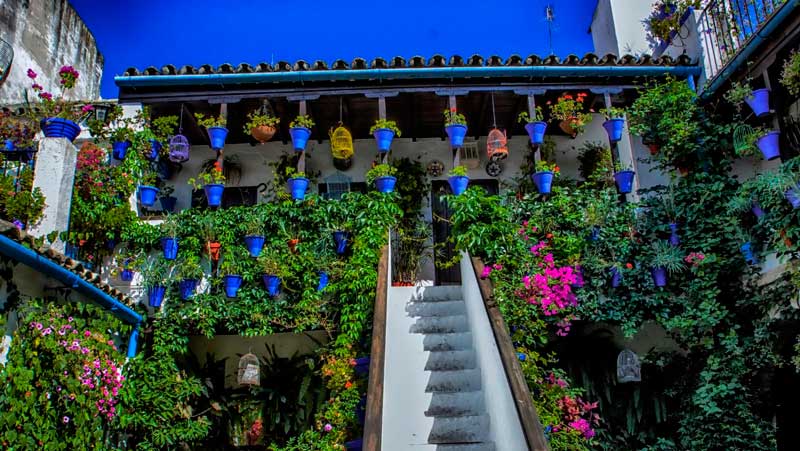
Córdoba’s patios are landscaped inner courtyards, adorned with potted plants and greenery against whitewashed walls, and this tradition is recognised as Intangible Cultural Heritage of Humanity. Many of them are open to the public free of charge or for a voluntary donation all year round, particularly in neighbourhoods such as San Basilio and Santa Marina.
It reaches its peak in May, when the Festival de los Patios de Córdoba and many local residents open their homes to the public free of charge. Outside these dates, simply strolling through the historic centre is an experience in itself: the network of narrow streets, the white-washed façades and the squares can be explored at your leisure and encapsulate much of the city’s charm.
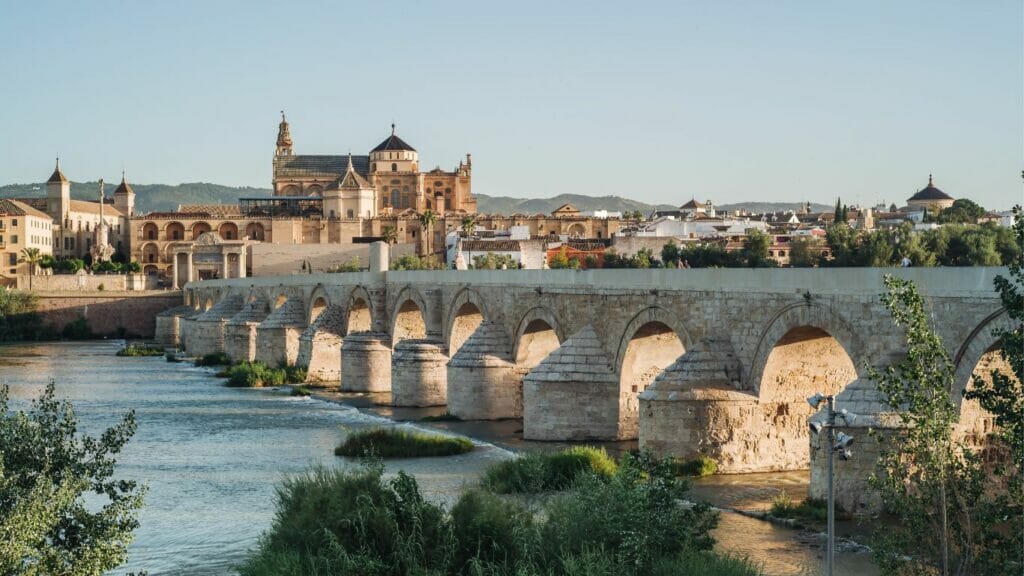
The Roman Bridge was built in the 1st century BC to span the Guadalquivir and facilitate the movement of people and goods. It is one of the oldest bridges in Europe; walking across it is free and it is also the best spot to catch the classic view of the Mosque-Cathedral silhouetted against the river, especially in the late afternoon.
At the southern end stands the Calahorra Tower, a fortification of Islamic origin which can be viewed and photographed from the outside free of charge; only the museum inside requires an admission fee. On the opposite side, the Puerta del Puente gate marks the entrance to the historic centre. The entire riverside promenade, with its mills on the river and the surroundings of the Guadalquivir, is free to access.
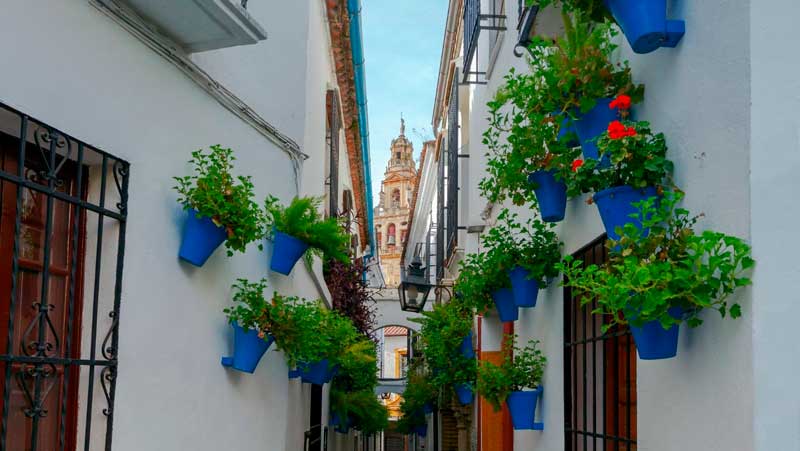
The Judería is the old Jewish quarter, a maze of narrow alleyways and whitewashed houses surrounding the Mosque-Cathedral, which visitors are free to explore. Within it, the Calleja de las Flores is one of the city’s most photographed spots: a short alleyway with flower pots hanging from the walls, leading to a small square from which the Mosque’s tower is framed in the background.
In the same neighbourhood are the statue of Maimonides and the Almodóvar Gate, alongside a section of the city walls, all of which are free to visit from the outside. You’ll also find the Córdoba Synagogue here – the only one still standing in Andalusia following the expulsion of 1492 – and the Casa de Sefarad, dedicated to Sephardic culture: both require an admission fee, but viewing them from the outside and strolling through the streets costs nothing. To find out more about its history and layout, there is a guide dedicated to What to see in Córdoba’s Jewish Quarter.
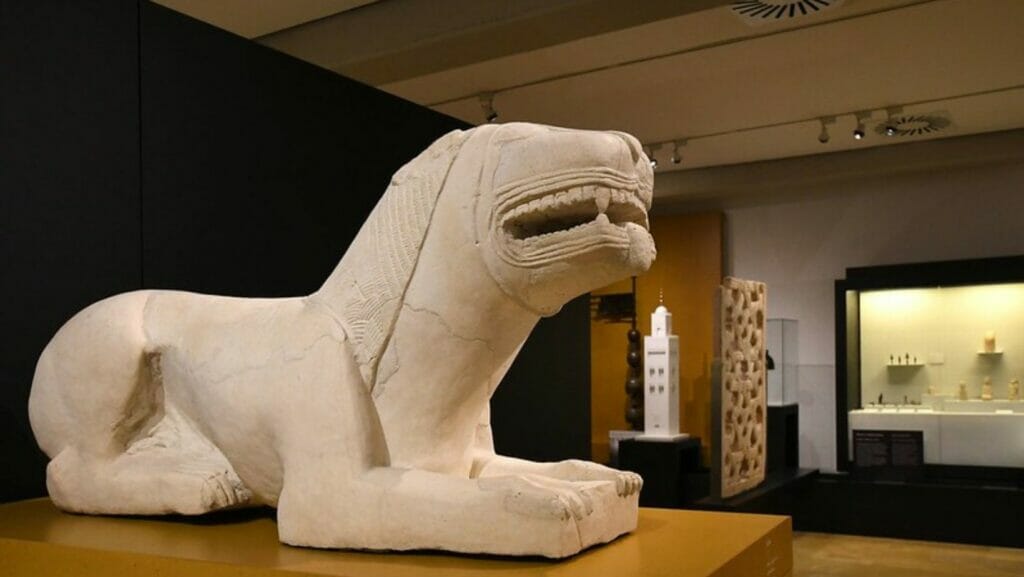
The Archaeological and Ethnological Museum of Córdoba is publicly owned and offers free access for European Union citizens, upon presentation of a valid document; for all other visitors, admission costs €1.50. It is advisable to check the terms and opening hours before you go.
It is situated in the Plaza de Jerónimo Páez, in the Palacio de los Páez de Castillejo, a Renaissance building erected on the remains of a Roman theatre, which can be seen as part of the tour itself. Its collection spans from Roman Córdoba to the medieval period, featuring pieces such as the Iberian lion from Nueva Carteya. It’s a good option for seeking shelter from the heat without having to pay an admission fee. Other sites in the city centre, such as the Roman Temple next to the Town Hall, can be viewed directly from the street.
Córdoba has several squares that serve as places to rest and soak up the atmosphere, free of charge. The Plaza de la Corredera, the only main square in Andalusia with a rectangular layout and arcades, still houses a market on the ground floor and is surrounded by terraces. The Plaza del Potro, mentioned in *Don Quixote*, brings together the old inn and two museums in a peaceful setting near the river.
Added to these are the Plaza de las Tendillas, the city’s nerve centre, and the promenades along the Guadalquivir, which offer the best panoramic views of the bridge and the Mosque-Cathedral at sunset.
The Cristo de los Faroles is a stone crucifix in the centre of the cosy Plaza de Capuchinos, surrounded by eight wrought-iron lanterns on pedestals. The simplicity of the setting and the night-time lighting give it a unique character, and it costs nothing to see it.
In the northern part of the city centre, there are other spots that are free to visit, such as the façade of the Palacio de Viana and the Fernandine churches, which you can admire from the outside whilst you’re out and about. Adding these stops to the squares and the exteriors of the major monuments completes a free walking tour covering almost the entire historic centre.
To make the most of the free entry, it’s best to get an early start: the Mosque-Cathedral, the courtyards and the streets of the Jewish Quarter are best enjoyed between 8.30 and 9.30 am, when there are fewer people and the light is more pleasant. Bear in mind that visitor numbers peak just before and just after this free period. Before you go, check the official websites for opening times, as these vary depending on the season and public holidays.
A one-day itinerary without admission fees could start at the Patio de los Naranjos and the exterior of the Mosque-Cathedral, continue through the Jewish Quarter and the Calleja de las Flores, cross the Roman Bridge and finish at the Plaza de la Corredera and the Plaza del Potro. If you’re visiting in May, the Festival de los Patios means dozens of patios are open to the public free of charge. To fit these plans into your wider city itinerary, return to the complete guide to Cordoba as a destination.
In Córdoba, you can visit the streets of the Jewish Quarter, the Calleja de las Flores, the Roman Bridge, the Patio de los Naranjos and the exterior of the Mosque-Cathedral free of charge, as well as squares such as the Corredera and the Plaza del Potro. Many of Córdoba’s patios are free to enter or operate on a voluntary donation basis, and the Archaeological Museum offers free admission to EU citizens. Much of the historic centre can be explored on foot without paying an entrance fee.
Monday to Saturday from 8.30 am to 9.30 am, with visitors required to leave from 9.20 am onwards. Visitors must enter individually and in silence; organised groups and guided tours are not permitted. On Sundays, entry is also free during liturgical services, provided you attend as a member of the congregation and do not take photographs. It is advisable to check the official website, as conditions may vary.
Yes, you can spend a day in Córdoba without paying any admission fees by focusing on the exterior views and the areas that are free to enter. One possible route starts in the area around the Mosque-Cathedral, continues through the Jewish Quarter and the Calleja de las Flores, crosses the Roman Bridge and ends at the squares in the city centre. If you want to go inside any monuments, it’s best to make the most of the free entry periods by getting there early in the morning.