The Málaga Fair is the city’s big summer festival and, in its 2026 edition, it will be held 15–22 August. Admission is free and open to all, and it has two very distinct sides: the daytime fair, which fills the historic centre with music and an open-air atmosphere, and the night-time fair, which moves to the Real del Cortijo de Torres with stalls, stages and attractions until the early hours. Understanding this dual nature is key to planning your visit effectively.
One key difference compared with other Andalusian fairs: In Málaga, almost all the festival tents are free to enter, unlike in Seville, where most are private and require an invitation. Here, you can get into almost any caseta without knowing anyone.
If you’re staying on the coast and want to pop into the capital during those days without having to worry about the car or parking, you can do so with a day trip to Málaga from the Costa del Sol, which covers the journey and leaves you with some free time to wander around the city centre. Below you’ll find the dates, the programme and some practical tips to help you make the most of the fair.
The 2026 Málaga Fair takes place from 15 to 22 August, from Saturday to Saturday. It comprises eight full days of festivities, kicking off on the evening of the first Saturday with the opening speech and the switching on of the lights at the Real, and ending the following Saturday.
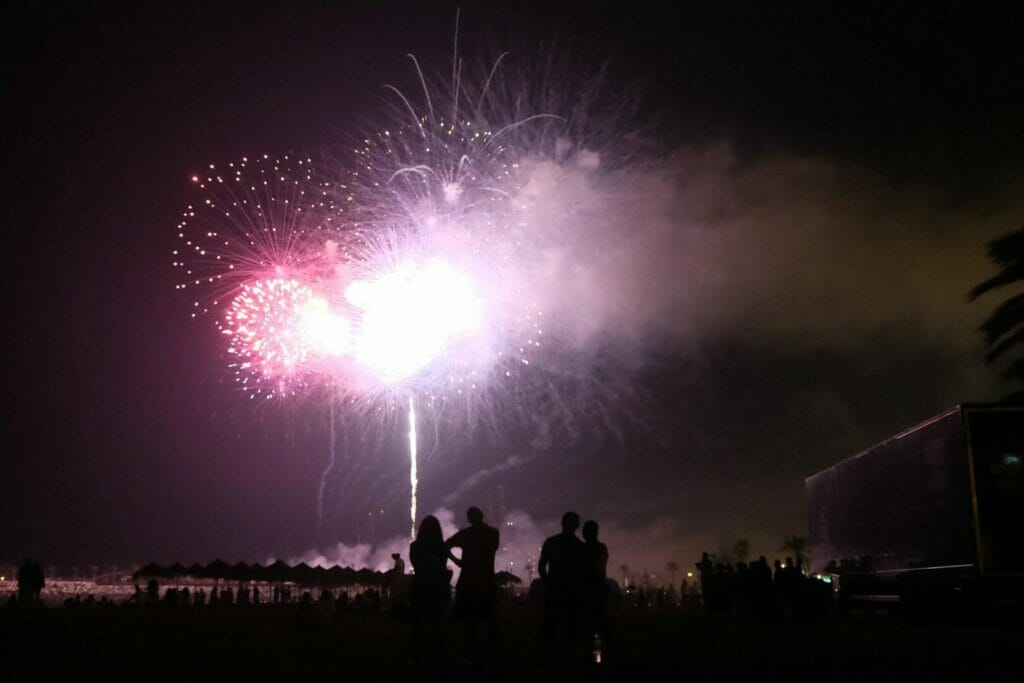
The day before, the 14 August, has its own programme: the Historical Parade, the fireworks display and a drone show on the city’s beaches. There’s no fair at the Real that night yet, but lots of people take the opportunity to head into the city centre. The best spots to watch the fireworks are the the beaches of La Misericordia, Huelin and La Malagueta, as well as Gibralfaro Castle.
The dates do not remain fixed from year to year, but always revolve around 19 August, the day on which Málaga’s incorporation into the Crown of Castile in 1487 is commemorated, following the conquest of the city by the Catholic Monarchs. That is why the fair takes place in the middle of the month and usually falls between two weekends. If you’re planning your trip in advance, bear in mind that accommodation in the city fills up weeks in advance.
The origins of the festival are directly linked to that historic date in 1487, when the Catholic Monarchs captured the city. To mark the anniversary, the city council organised a series of celebrations which, over time, became established as Málaga’s main festival. This is where its other popular name comes from: the August Fair.
That historical legacy remains evident in the programme through the Historical Horse Parade, a parade featuring period costumes that re-enacts the entry of the Catholic Monarchs into the city and winds its way through the city centre to the Cathedral.
During the 20th century, the fair grew to the point where it spilled over into the city centre. The night-time section, with its marquees and fairground rides, eventually moved to its own site on the outskirts – the Real del Cortijo de Torres – whilst the historic centre retained its daytime atmosphere. This separation between the daytime and night-time parts of the fair, which today defines the festival, is the result of this evolution and the need to accommodate hundreds of thousands of visitors.
The fair begins on the first Saturday, which in 2026 is the 15 August. The event marking the official start is the opening speech, which takes place that very evening and is followed by the lighting of the main entrance and the fairground.
Since 2022, the opening speech has been held on the first Saturday of the fair at the Royal Farmhouse of Torres, on a stage set up in front of the main entrance, on Avenida de Las Malagueñas, a few minutes before the lights were switched on.
The town crier of the Juan Francisco Funes is the 2026 Málaga Fair, the Málaga CF manager, who will deliver the opening address on the evening of Saturday 15 August. He thus joins a list of previous speakers that includes Antonio Banderas, Pablo Alborán, María Teresa Campos, Chiquito de la Calzada, Dani Rovira, Estrella Morente and El Kanka.
That same Saturday also sees the pilgrimage with the standard-bearer, which starts at the Town Hall and ends at the Santuario de la Victoria, where the town’s flag remains hoisted throughout the week of the fair. The 2026 flag-bearer is the actress María Barranco.
From that very first night, the festivities are in full swing: throughout the week, the daytime fair in the town centre and the night-time fair at the Real run side by side, each with its own opening hours and atmosphere.
The fair is enjoyed in very different ways depending on the time of day. In the morning and until mid-afternoon, the action is in the city centre; as night falls, the focus shifts to the fairground. If you’re planning to spend the whole day in the city, combine the fair with a tour of the monuments: here’s a handy guide to what to see in Malaga in one day to make the most of the time when you’re not in the thick of the party.
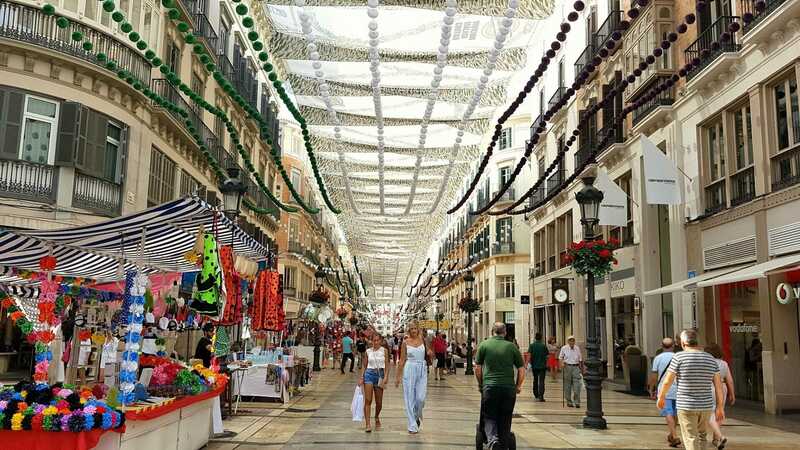
The daytime festivities take place in the historic centre, particularly in the Marqués de Larios Street, the Plaza de la Constitución and the surrounding streets. There are live music every day from 12:00 in the Plaza de la Constitución, Plaza del Obispo, Plaza de las Flores and Plaza de San Pedro de Alcántara, until 6.00 pm, at which point the street music stops and the festivities continue inside licensed venues.
The atmosphere is daytime and open-air: groups playing verdiales, people dressed in flamenco attire, the gateway at the start of Calle Larios, and lanterns and flowers lining the route. It’s the most accessible and family-friendly side of the fair, ideal for a leisurely stroll.
For the little ones, the Plaza de la Merced It features a play area, theatre workshops and puppet shows, running from 12.00 to 15.30 from Sunday onwards. It’s also the perfect time to take a break and have lunch in the area: if you’re new to the city, our selection of where to eat in Malaga.
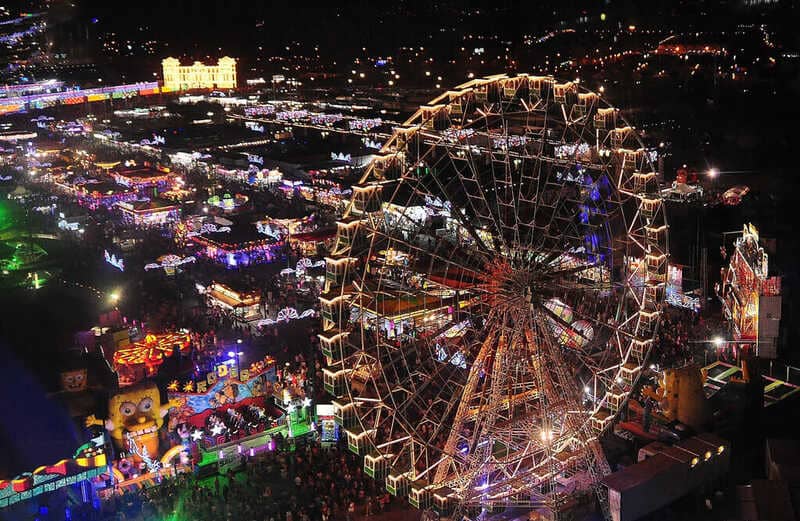
As night falls, the party moves to the Cortijo de Torres Exhibition Centre, on the outskirts. This is where you’ll find the marquees, the concert stages, the illuminated entrance arch and the fairground, which stays open well into the early hours. The festivities take place across the Auditorium, the Explanada de la Juventud and the marquees.
In the There are free live performances in the auditorium every night from 10.30 pm, and the Municipal Children’s Marquee is organising activities for children from 9.30 pm. The fairground area is set slightly apart from the marquees, designed with families in mind.
It’s worth bearing in mind that the Real is some way from the city centre, so you’ll need to plan your journey accordingly, especially for the return journey in the early hours.
The official programme is published each year by the Town Council and via municipal channels a few weeks before the festival begins, featuring the concerts, timetables and a map of the venue. You can view it at the official website of the Málaga Fair.
The structure is the same in every issue, giving you an idea of what to expect. The programme usually includes:
The poster is selected through a public competition open to artists of any nationality, with each participant submitting one original and unpublished work. The 2026 poster is Flowers for Victory, by Patricia Castro Bohórquez.
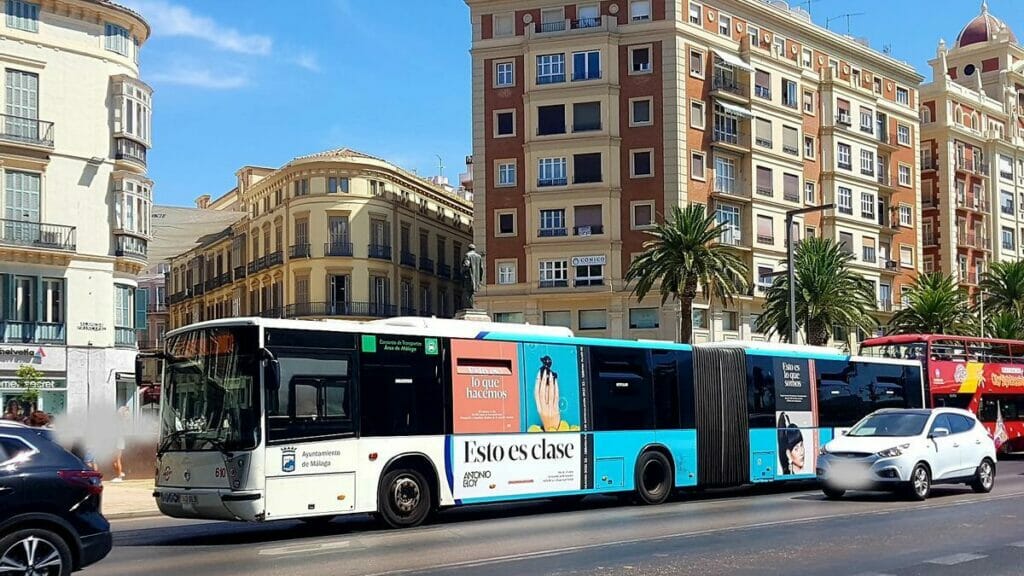
There’s no mystery about getting to the daytime fair: the historic centre is pedestrianised and you can walk there from almost anywhere in the town centre. It’s a different story with the night-time fair, because the Real del Cortijo de Torres is about four kilometres from the centre and walking there isn’t recommended.
Here are the options for getting to the venue:
If you’re coming from the Costa del Sol, plan your return journey in advance, as long-distance public transport runs less frequently in the early hours of the morning.
The August fair is the main festival, but Málaga’s calendar features other events throughout the year. You can find them all listed in the guide to Traditions and festivals in Málaga, which serves as a starting point for planning your visit at any time of year.
Among the most notable celebrations are the Easter Week in Malaga, with its thrones and its procession through the city centre in spring, and Málaga’s ‘Noche en Blanco’, a cultural event during which museums and monuments stay open until the early hours of the morning. Each one has its own character and takes place at a different time of year.
If you’d prefer to mix up your time at the fair with trips out of town, or make the most of your mornings to explore the province, here are some day trips that depart from Málaga and the Costa del Sol. You could also spend a morning Explore the city and its 10 must-see attractions.
The 2026 Málaga Fair takes place from 15 to 22 August, running from Saturday to Saturday. It begins on the evening of the first Saturday with the opening speech and the switching on of the lights, and continues for eight days with daytime festivities in the city centre and evening festivities at the Real del Cortijo de Torres. On the eve of the festival, 14 August, there is a Historical Parade, fireworks and a drone show on the beaches.
The festival kicks off on the evening of Saturday 15 August 2026. The opening speech takes place at the Real Cortijo de Torres, opposite the main entrance, a few minutes before the lights are switched on. The 2026 opening speaker is Juan Francisco Funes, manager of Málaga CF. On the same day, the procession of the flag-bearer takes place; this year, the role is held by the actress María Barranco.
Yes. Entry to the Málaga Fair is free of charge, both in the historic centre and at the Real del Cortijo de Torres, and in Málaga almost all the marquees are open to the public, unlike at other Andalusian fairs. The concerts at the Auditorium are also free of charge. The cost depends on what each visitor spends or which attractions they choose to go on.
The daytime festivities take place in the historic centre, in streets such as Marqués de Larios and the squares of La Constitución, El Obispo, Las Flores and San Pedro de Alcántara, with live music from 12:00 to 18:00. The night-time festivities move to the Real del Cortijo de Torres, where the marquees, stages and fairground rides are located, and which remain open until the early hours.
The Real del Cortijo de Torres is about four kilometres from the city centre, so it’s not a good idea to walk there. The most practical option is the F bus route, which runs between the city centre and the venue 24 hours a day for €2 a ticket. Bus routes 4, 18, 19, 20 and 22 are also available, and a taxi is the most comfortable option for the return journey in the early hours. If travelling by car, parking is limited on busy days.