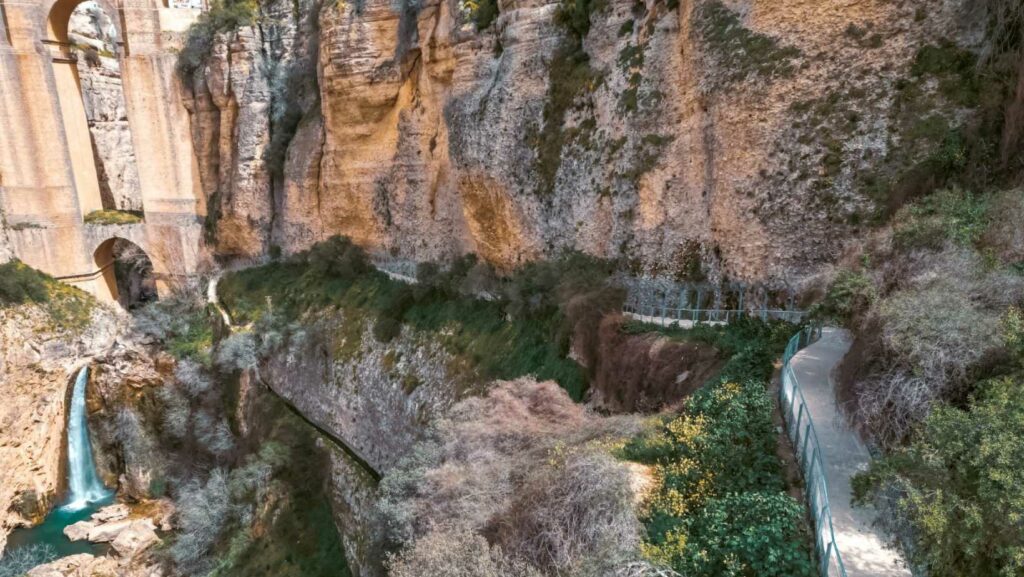
The The Tajo Gorge Trail go down to the base of the "Puente Nuevo", from inside your throat. It’s the opposite perspective to the one you’ve always had: instead of leaning over the precipice, you look up at it from below.
It opened in April 2024 and it’s still operating at reduced capacity. Here’s all the practical information, and I’ll start with the most frustrating bit.
Children under the age of 8 are not permitted entry. No exceptions.
The problem is that The entry control is downstairs, at the bottom of the slope leading down from María Auxiliadora Square. Some families walk all the way down only to find that their child can’t get through; the usual solution ends up being for one of the two adults to go in whilst the other stays outside to wait.
And you must bring the following documents: Those aged 8 and over must present Original National Identity Card or Family Register to prove their age, and to be accompanied by an adult.
Nor is it accessible: It is not accessible to wheelchair users or pushchairs, because they would hinder an evacuation.
Están abiertos de lunes a domingo y los horarios lo puedes encontrar in the official website
Please note the access cut-off time: It does not match the closing time. We are no longer admitting people one hour earlier once each section is finished, so take your time.
Confirm the time on the day itself on the official website: the footpath closed due to rain or a rising river, which is quite common in winter.
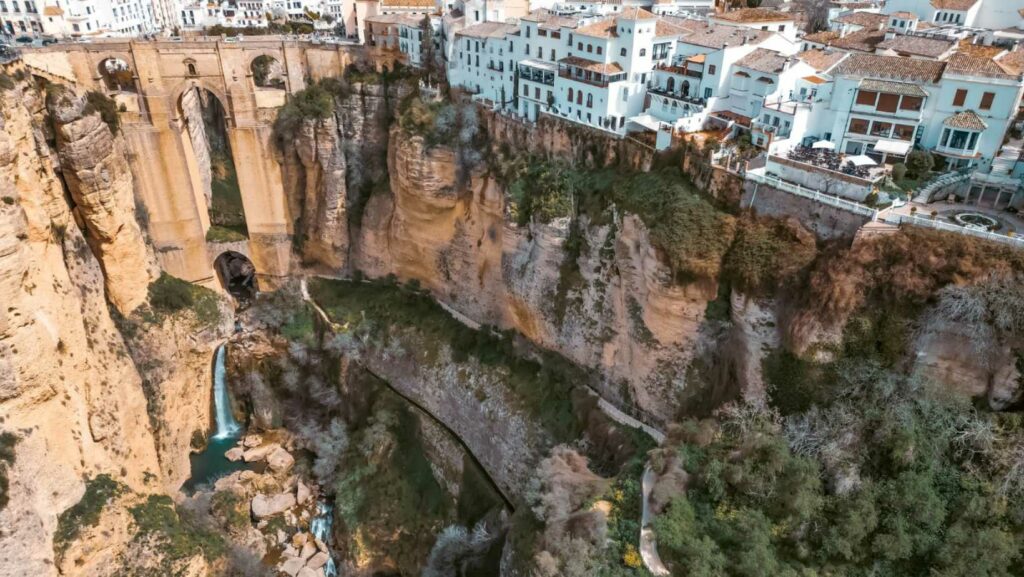
It is a 250-metre-long footbridge from María Auxiliadora Square to the foot of the bridge, clinging to the rock a few metres from the Guadalevín. It follows the route of the a path that was cleared in the 18th century to transport materials uphill during the construction of the Puente Nuevo.
Let’s be clear about the duration: The return journey takes 30 minutes, and some people cover it in ten. It’s short. If you’re expecting a long route like the Caminito del Rey, this isn’t it: people come here specifically to see the bridge from its base and to admire the river’s pools and waterfalls.
Along the way there are QR codes with information and viewing points overlooking the Hoya del Tajo. From certain vantage points, you can see the three bridges in Ronda: the New, the Old and the Roman.
La segunda fase ya está abierta al público desde el 16 de septiembre de 2026, por lo que actualmente es posible completar el recorrido de casi un kilómetro por el corazón de la Garganta del Tajo, desde la plaza de María Auxiliadora hasta la zona de los Baños Árabes.
El proyecto completo, con una inversión de más de 1,5 millones de euros, ya está terminado. La segunda fase del The Tajo Gorge Trail añade unos 500 metros al recorrido, permitiendo adentrarse aún más en la garganta y disfrutar de una perspectiva completamente diferente del Tajo de Ronda. Con acceso a las plataformas del antiguo the Molinos Harineros weirthe hydroelectric power station and the Huertas del Tajo.
There are quite a few rules, and it’s worth knowing them so you don’t get a nasty surprise at the checkpoint:
What you do need to bring: hiking boots with grippy soles — there are wet sections due to the proximity to the water —, water, and a cap and sun cream if it’s sunny.
The entrance is in María Auxiliadora Square. Walk to the end of the viewing platform’s balconies and you’ll see the path leading down towards the Casa del Manolillo, where the entry checkpoint is.
From Malaga There are a few 100 kilometres: Take the A-357 to Ardales and then the A-367, which has a few bends on the final stretch. It takes about an hour and a bit. There is also a regional train to Ronda station, just a few minutes’ walk from the town centre.
As the trail is short, It doesn’t matter what time you do it: it fits into any gap in your day. You can find the rest of Ronda at What to see in Ronda.
And if you’re looking for a really long catwalk, that’s the Caminito del Rey: that’s 7.7 km compared to these 250 metres. You can find their recommendations at Is the Caminito del Rey dangerous?.
We are a local tour operator based in Málaga with over 50 years’ experience organising trips around Andalusia. If you’d rather avoid the mountain roads, the excursion includes a guided tour of Ronda with admission to the Don Bosco House Museum, some free time in Setenil and a glass of wine whilst enjoying the views of the Puente Nuevo:
Note: the entrance to the Gorge is not included on the excursion. If you’d like to do this, book it separately on the official website and make sure the time fits in with your free time.
Children under the age of 8 are not permitted entry, and there are no exceptions. It’s worth knowing this before you head down, as the entry checkpoint is at the bottom of the slope from María Auxiliadora Square, and several families have found themselves there only to be told that their child couldn’t enter. Children aged 8 and over must carry their original ID card or family register and be accompanied by an adult.
General admission costs 5 euros, with a maximum of four tickets per purchase, and can be bought on the official website desfiladerodeltajo.info or by scanning the QR codes displayed in various establishments around Ronda. Capacity is limited to 30 people per hour, so it is advisable to book in advance. Residents registered in Ronda can enter for free without a prior booking by showing their ID card.
It takes about 30 minutes there and back, though some people manage it in ten. It’s a 250-metre walkway from Plaza de María Auxiliadora to the foot of the Puente Nuevo. It’s a short walk, so it’s worth bearing that in mind: the highlight is the view of the bridge from below and the pools of the Guadalevín, not the length of the walk itself.
No. You are not permitted to enter with a wheelchair, pushchair or any other item that might hinder an evacuation, and walking sticks and crutches are also not allowed on the footbridge. The route includes changes in level and flights of stairs, and the surface may be wet due to the proximity of the river.
Work on the so-called Tajo Gorge Walkway began in October 2024 and will extend the route by around 500 metres into the steepest part of the gorge, providing access to the platforms of the old Molinos Harineros weir and the hydroelectric power station. It is advisable to check the status on the official website before visiting, as the route may have changed. The first phase has remained open throughout the works.
El sendero cierra por lluvia o por crecida del río, algo habitual en invierno, así que conviene confirmar el horario el mismo día en la web oficial. Si llueve durante la visita, está prohibido el uso de paraguas y es obligatorio llevar chubasquero o similar