In Seville, the squares are the city’s living room: where you soak up the sun in January, seek the shade in August and linger to enjoy some tapas.
Ten squares, from the most monumental to the most hidden, so you need to look at what each one has to offer.
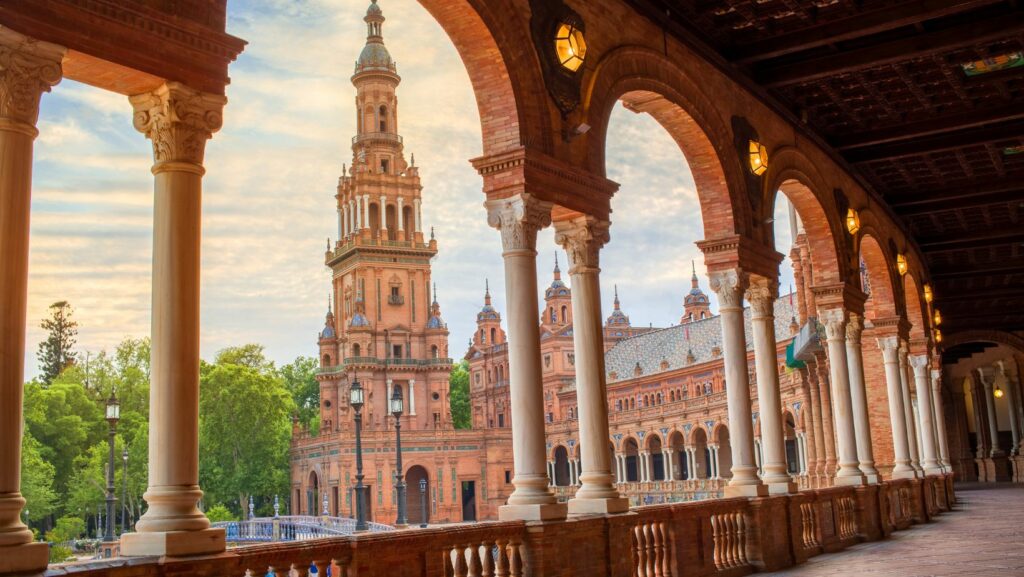
By far the most spectacular. He built it Aníbal González for the 1929 Ibero-American Exhibition, in María Luisa Park.
What to look for:
Go at sunset: That’s when the pottery comes to life. Find out all the details at the Plaza de España.
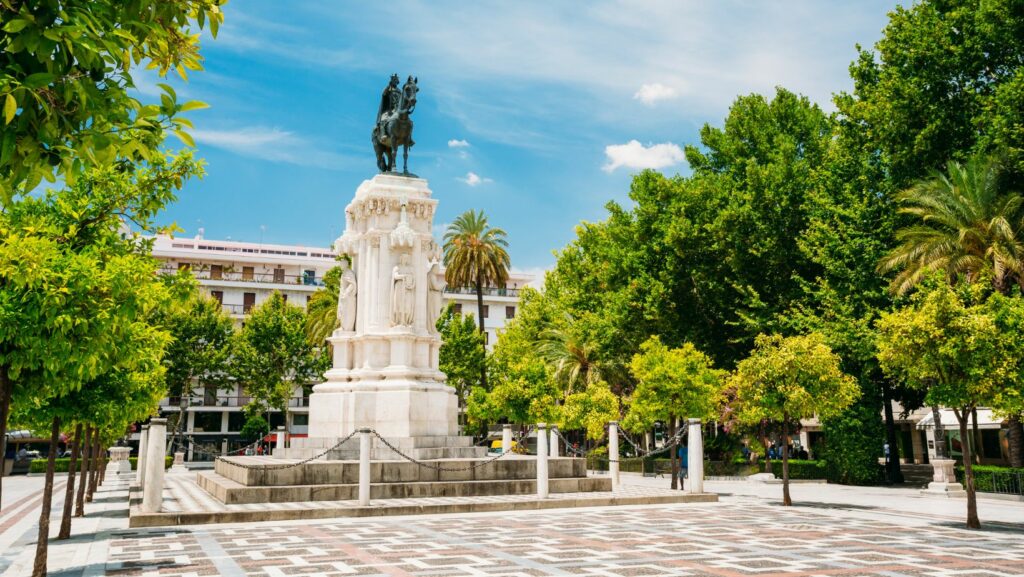
The large public square in the town centre, with palm trees, orange trees and the tram running through it. Here is the Town Hall.
One detail that confuses everyone: The famous 16th-century Plateresque façade does not face onto Plaza Nueva, but on the other side of the building, at the San Francisco Square. It’s worth making a detour.
In the centre, the equestrian monument to Fernando III, which conquered the city in 1248, inaugurated in 1924.
It is called «Nueva» (New) because it was built in the 19th century on the site of the former convent of San Francisco, which explains its regular layout in contrast to the surrounding medieval labyrinth.
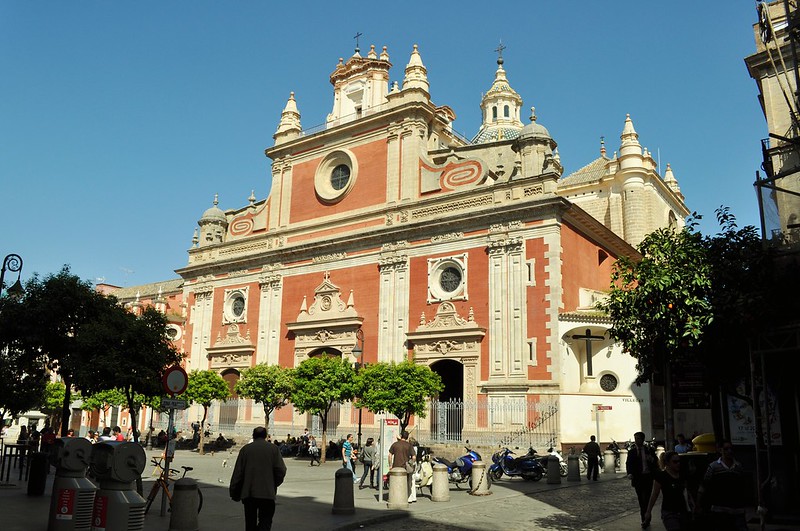
The tapas square. That’s normal here to have a drink whilst standing in the square itself, and by late afternoon it’s full.
It is dominated by the Collegiate Church of the Divine Saviour, the city’s second-largest church after the Cathedral, with a reddish Baroque façade.
And here’s a little-known historical fact: he got up on the former main mosque of Almohad Seville, y traces of it can still be seen in its courtyard.
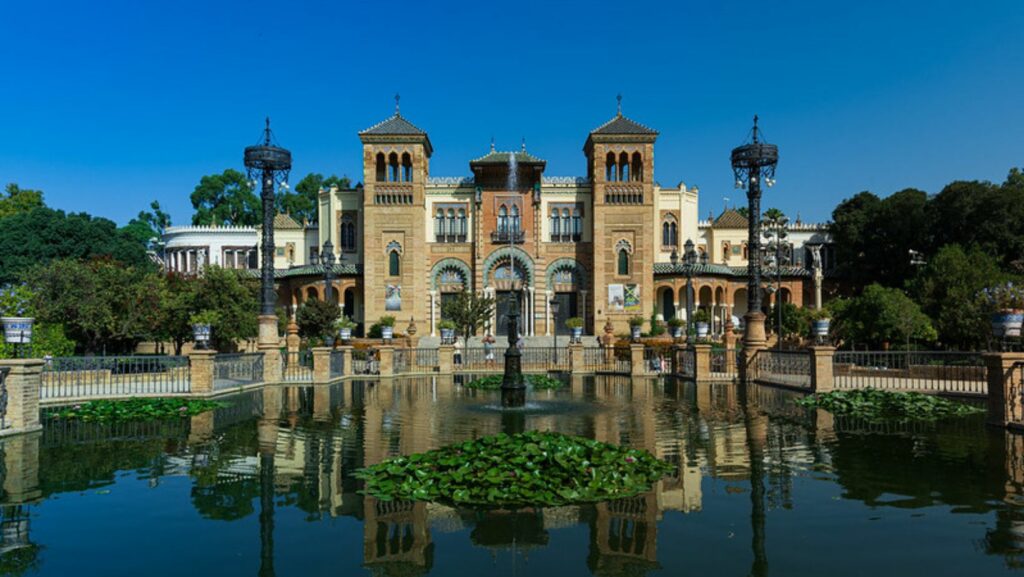
The other end of María Luisa Park, also by Aníbal González and dating from 1929. It is known as the pigeons’ corner.
What’s interesting is that the three buildings are in three different styles, by the way:
It is the quietest of the monumental squares, with a water lily pond and plenty of shade.
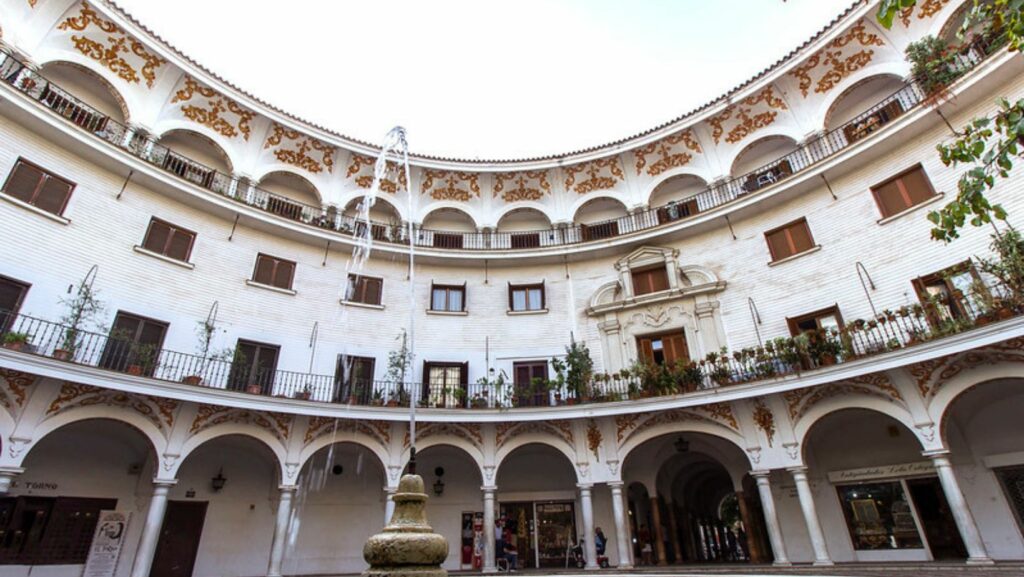
The most hidden one, and the one that surprises you the most. You can visit opposite the Cathedral, on the other side of Avenida de la Constitución, and you go in through a passageway beneath a building. If you don’t know it’s there, you walk right past it.
And here’s the best story on the list. In the early 20th century, plans were drawn up for a large square to create more space around the cathedral, and the buildings opposite were demolished.
However, remains of the Almohad wall were discovered during the building works. Between that and the spiralling costs, the council changed its plans and ended up building this semi-circular square. The remains of the wall are still visible inside.
It is worth clarifying this because it is often said that the square dates from a 16th-century convent and that the remains are Roman. They are, in fact, Almohad.
In the 16th and 17th centuries, there was an open-air theatre here where Cervantes premiered his plays, until the local council banned the performances.
Legend has it that the palace of Don Gonzalo de Ulloa once stood on this site, the Commander, Doña Inés’s father, the impossible love of the Don Juan Tenorio by José Zorrilla.
It’s just a stone’s throw from the Arenal neighbourhood.
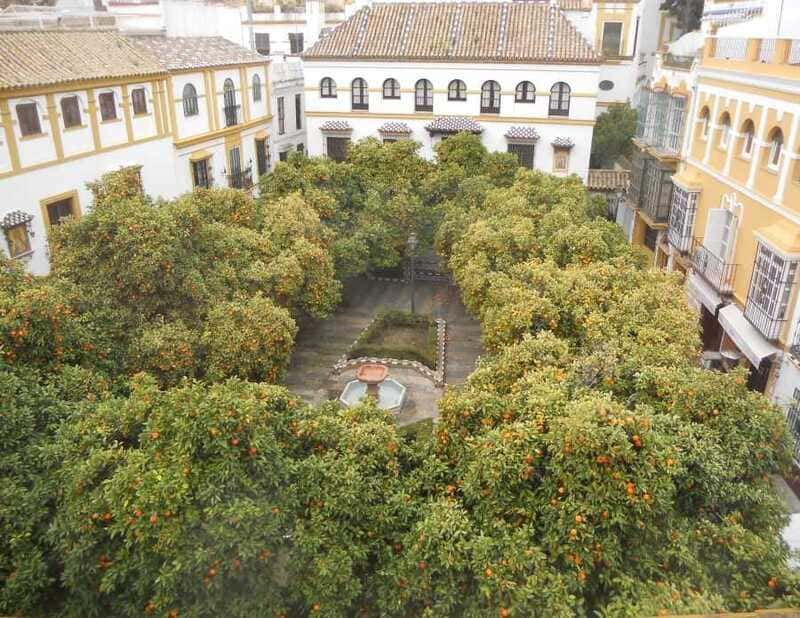
The most recognisable sight in Santa Cruz: small and square, with orange trees, tile benches and a central fountain.
Spring is the best time to visit, with orange blossom. And at midday, because the shade from the orange trees makes it bearable in summer.
His pen name: Tradition links her to Doña Inés de Ulloa, the heroine of the Don Juan Tenorio by José Zorrilla. Mind you, this is often confused: the play is by Zorrilla, not by Tirso de Molina, who wrote *El burlador de Sevilla* about the same character.
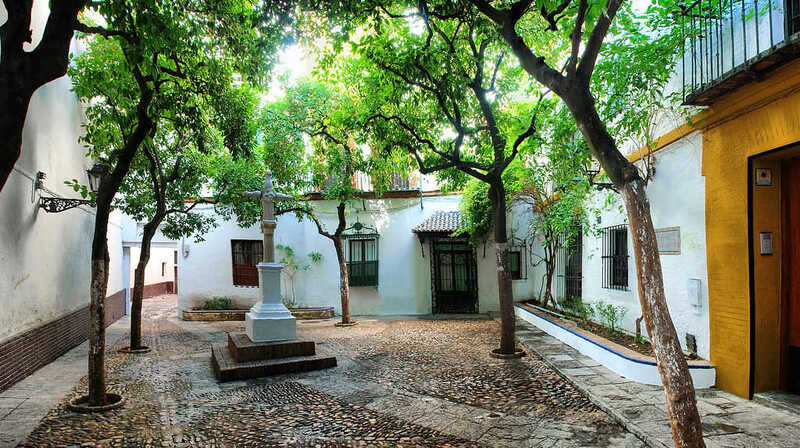
The hardest to find of them all. The entrance is via a narrow passageway leading off Mateos Gago Street or from Plaza Virgen de los Reyes, and when you arrive, it looks more like a private courtyard than a square.
What's up: a iron cross on stone steps —the Cross of Santa Marta—, four orange trees and whitewashed façades. Nothing else.
And that is precisely what makes it special: It is thirty metres from the busiest spot in Seville, and you can hear nothing but the bells.
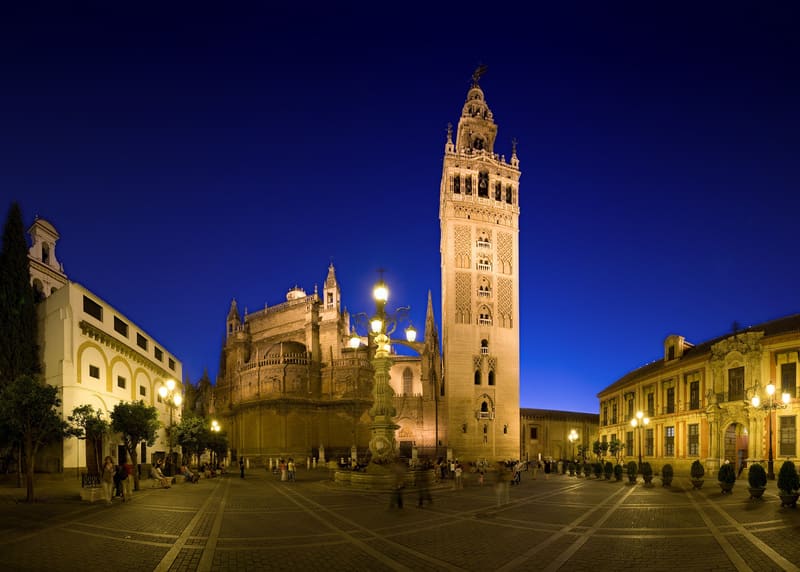
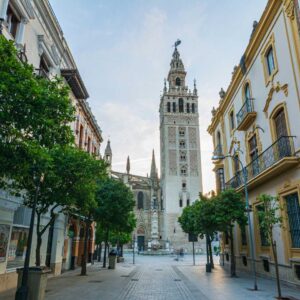
A postcard of Seville. This is where they come together the Cathedral with the Giralda, the Archbishop’s Palace and the Convent of La Encarnación.
In the centre, the Farola Fountain, an early 20th-century sculpture crowned by four angels and featuring street lamps, from which it takes its name.
This is the setting for Holy Week: The major religious processions pass through here, and this is where the largest crowds gather during those days.
From here, you enter the Cathedral and to the Giralda.
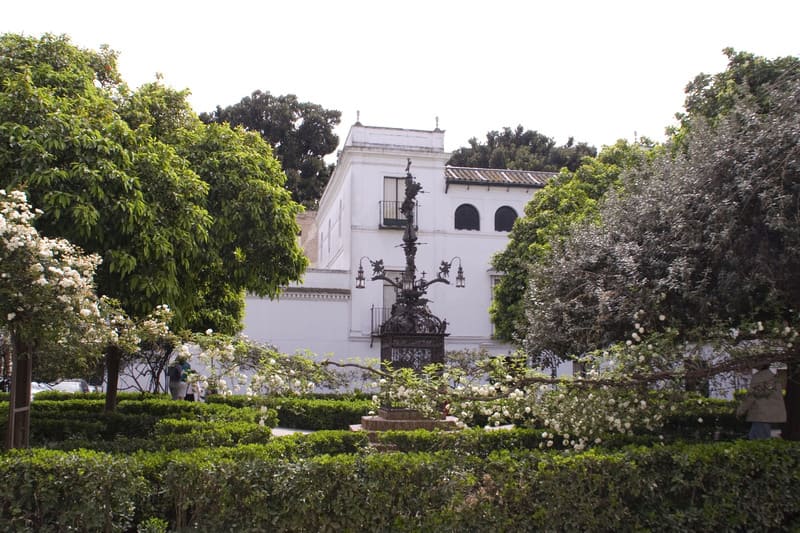
It gives its name to the whole neighbourhood. Landscaped, with orange trees and stately homes all around.
In the centre stands the Cruz de la Cerrajería, a 17th-century wrought-iron cross considered a masterpiece of Sevillian ironwork. It’s not from here: was originally on Sierpes Street, which is why it is also known as the Cruz de las Sierpes.
And what was there before: a church demolished during the French occupation, where Murillo was buried.
Just a stone’s throw away are the Murillo Gardens and the Callejón del Agua, which runs right alongside the Alcázar walls.
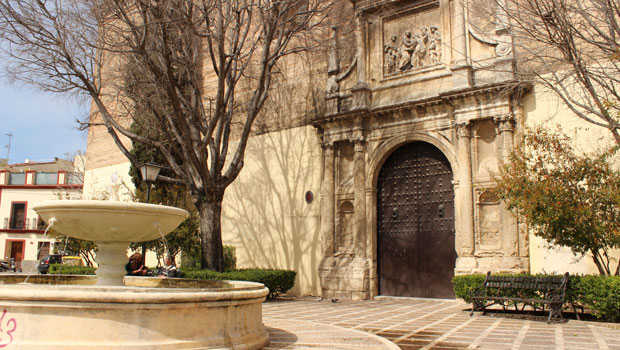
The only one on the list without any tourists. It’s in the San Julián neighbourhood, to the north of the old town, and here it has a real neighbourhood feel.
It is dominated by the Convent of Santa Isabel, a Poor Clare convent, founded in the 16th century, with Baroque marble façade.
And what’s nearby makes the walk worthwhile: on Feria Market, one of the oldest in Seville, and the St Mark’s Church, Gothic-Mudejar in style with a tower reminiscent of the Almohad period.
They are in two separate areas, and it is best not to mix them up:
The Town Council, on Sunday mornings, which is when the street market is on.
Others worth mentioning: the Plaza del Triunfo, between the Cathedral and the Alcázar, and the Refiners' Squarewith its monument to Don Juan Tenorio.
We are a local tour operator based in Málaga with over 50 years’ experience organising trips around Andalusia. Seville is best explored in a day:
More about the destination: what to see in Seville, Seville in a day, the Royal Alcázar y their courtyards.
The Plaza de España is the most spectacular, with its 48 tiled benches dedicated to the provinces, the navigable canal and the two towers. Of the smaller squares, Doña Elvira in Santa Cruz is the most photographed, whilst the Cabildo square is the most surprising as it is hidden away behind a passageway.
Opposite the Cathedral, on the other side of Avenida de la Constitución, it is accessed via a passageway beneath a building, which is why many people walk right past it without noticing it. Inside, visible remains of the Almohad city wall can still be seen.
Due to a change of plans. In the early 20th century, the buildings opposite the Cathedral were demolished to create a large square that would give it a more spacious feel, but during the works, remains of the Almohad wall were uncovered and the cost soared. The City Council then decided to build this semi-circular square, incorporating the remains that had been found.
By José Zorrilla, who wrote it in 1844. It is a common mistake to attribute it to Tirso de Molina, the author of *El burlador de Sevilla*, an earlier play about the same character. The Plaza de Doña Elvira and the Plaza del Cabildo are traditionally associated with the settings of Zorrilla’s version.
Virgen de los Reyes next to the Giralda, Santa Marta tucked away behind a passageway, Doña Elvira and Santa Cruz in the Santa Cruz neighbourhood, and the Cabildo church on the other side of Avenida de la Constitución. You can walk between them all in about two hours. Plaza Nueva and Plaza del Salvador are a little further north, in the shopping district.
On Sunday mornings, there are stamp and coin stalls under the arcades. It is also a meeting place for families who come to swap trading cards, making it the liveliest day of the week in the square.