The wine from Málaga It is one of the oldest in Spain: the Phoenicians were already planting vines here more than 2,500 years ago, and for centuries this sweet wine from Málaga was exported to half of Europe, where it was known as «Mountain» coming from the slopes of the mountains.
Here you have what types there are, what grapes they’re made from and where to try them, with the actual opening hours for each venue – which is where most people are in for a disappointment.
For two reasons that go hand in hand. The first is the weather: plenty of sunshine and dry summers concentrate the sugar in the grapes, enabling the production of wines naturally sweet without added sugar.
The second is a traditional technique, the sunbathing: leave the grapes to dry in the sun on songbirds until they are almost like raisins. This produces very concentrated musts, with aromas of raisins, figs, honey and nuts.
Both are white and are vinified either on their own or blended. The Muscat also produces dry wines, not just sweets.
If you’re only going to try one, make it this one. The Cartojal is a a pale, sweet and fresh Muscat, and it is the unofficial wine of the Malaga Fair: in August, people drink it from glasses all over the city. It is served very cold and it’s available all year round, although the fair is when it’s at its best.
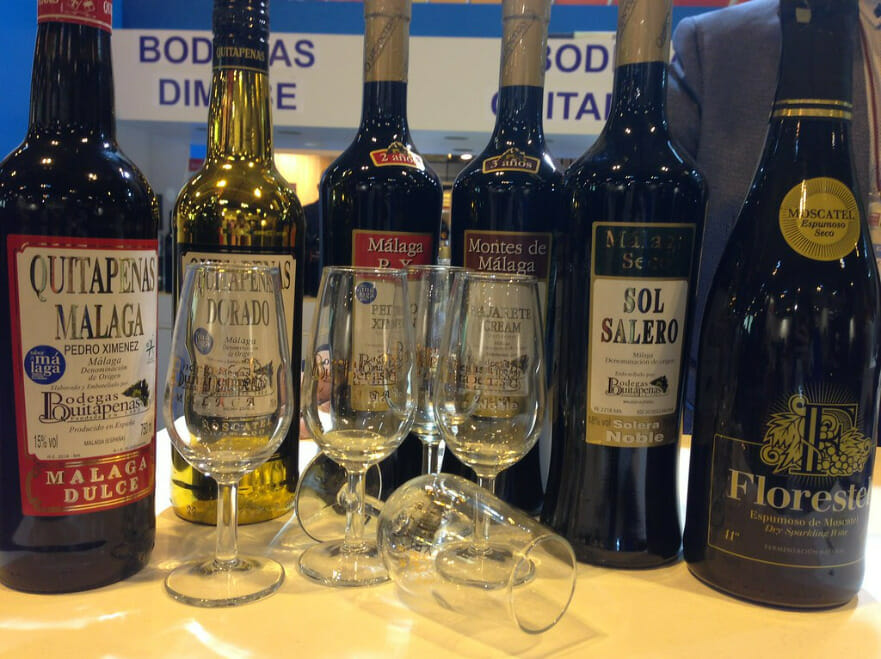
The classic style: concentrated musts, often made from sun-dried grapes, aged in oak barrels, with amber hues. The term Malaga, the Virgin refers to the naturally sweet, with no added alcohol, whose sugar comes solely from the grapes. It goes well with desserts, mature cheeses or as an after-dinner drink, and should always be served chilled.
This deserves an explanation, because it is often misrepresented. ‘Lágrima’ is neither a sparkling wine nor a brand: is the wine that comes from the must and yolk, which flows from the grapes simply due to the weight of the bunch, without pressing it.
As each batch yields only a very small amount, it is the most delicate and rare of all the wines from Málaga. If you see it on a wine list, do order it.
A dark, semi-sweet wine, aged through oxidation, with less sugar than the classic sweet variety. It is the one that the people of Málaga ask for in the traditional taverns, and is probably the least well-known to visitors.
In recent decades, the following have gained prominence: young white Muscat wines, which retain the flavour but are sugar-free, and the red wines from the Serranía de Ronda, made with Tempranillo, Syrah, Cabernet Sauvignon and Petit Verdot, amongst others.
The province has two names, which are administered by the same regulatory body, and care should be taken not to confuse them:
In addition to these, there is the name of the Raisins from Málaga, which protects sun-dried Muscat grapes.
Please note the opening hours, as all three close at rather unusual times.
The oldest tavern in Málaga, founded in 1840, in the 18 Alameda Principal. With almost 11,000 reviews and a rating of 4.6, is the place not to be missed.
How it works: it is drunk standing, at the bar, with the barrels behind. The wine is served straight from the barrel and They write the bill down for you in chalk on the counter. Ask for a Little Bird, which is the speciality, or a dry one. It’s one of the cheapest things you’ll find in the city centre.
Opening hours: Monday to Saturday, 11.00–17.30. Closed on Sundays and not open in the evenings. It’s the most common mistake: lots of people go there for dinner only to find it’s closed.
In the Plaza de los Viñeros, in an 18th-century palace. It houses a collection of old posters, labels, soil samples and winemaking tools, and explains the two designations. The ticket includes a tasting of two wines.
Opening hours: Monday to Friday, 10.00–17.00. Closed on Saturdays and Sundays. This is the most important notice on the whole page: it is the best introduction to Malaga wine and It’s closed this weekend, which is when most visitors arrive. It is also advisable to book a day in advance.
If you want to see where the wine is made, there are two areas:
The Axarquía, a land of Muscat grapes on slate-covered slopes. Here they are Bentomiz Winery, in Sayalonga, known for its wines Ariyanas; Dimobe Winery, in Moclinejo, one of the oldest still in operation; and Jorge Ordóñez, whose sweet Muscat wines are internationally renowned.
The Ronda Mountains, the red wine region. Of particular note is Descalzos Viejos, housed in a former 16th-century convent overlooking the Tagus, and Doña Felisa. They go well with a visit to Ronda.
In the capital, Quitapenas Winery It retains the traditional Malaga production method. Almost all of them require booking in advance for the tour with tasting.
You can find the rest of the table at traditional dishes from Málaga, and a good product to take with you on the Atarazanas Market.
We are a local tour operator based in Málaga with over 50 years’ experience organising tours around Andalusia. These tours cover the province’s two wine-growing regions:
For the rest of the plan, you have what to see in Malaga y Málaga in three days.
Sweet wine, made from concentrated musts of Pedro Ximénez and Muscat, often using sun-dried grapes. This is the style that brought the city international fame, with amber hues and aromas of raisins, honey and nuts. The most popular among the people of Málaga is Cartojal, a pale, fresh Muscat which is the unofficial wine of the Málaga Fair.
It is neither a sparkling wine nor a brand, but rather the wine obtained from the free-run juice: the juice that flows from the grapes simply due to the weight of the bunch, without pressing. As only a very small quantity is obtained from each batch, it is the most delicate and rare of Málaga’s wines, and is produced in both sweet and lighter styles.
The classic spot is the Antigua Casa de Guardia, on the Alameda Principal, founded in 1840, where you drink standing up and the wine is served straight from the barrel, with the bill marked up in chalk. It’s open Monday to Saturday from 11.00 to 17.30 and closed on Sundays, so it’s not suitable for dinner. An alternative that’s open every day is the Restaurante La Deriva, on the Alameda de Colón.
Monday to Friday, from 10.00 to 17.00, and closed on Saturdays and Sundays. This is important to note because it offers the best introduction to the province’s wines and is closed at the very weekend. Admission includes a tasting of two wines, and it’s advisable to book a day in advance. It’s located in Plaza de los Viñeros, in an 18th-century palace.
The Málaga PDO is the oldest and covers traditional sweet and fortified wines, made mainly from Pedro Ximénez and Muscat grapes. The more recent Sierras de Málaga PDO recognises still and dry wines — white, red and rosé — from areas such as the Serranía de Ronda, the Axarquía and the Montes de Málaga. Both are managed by the same regulatory council.
A pale, sweet and fresh Muscat, known as the wine of the Málaga Fair, where it is drunk by the glass throughout the city during that week in August. It is served very cold and can be found all year round, although its natural place is at the fair. It is probably the most popular wine from Málaga amongst the locals themselves.